
Article
API integration strategy for secure enterprise data flows
A sound API integration strategy for enterprises connects applications so they can exchange data and trigger workflows without manual hand-offs….
Jowena Borral · Software development · 27 October 2026

A sound API integration strategy for enterprises connects applications so they can exchange data and trigger workflows without manual hand-offs. Start with a business outcome, then map the systems and data involved before choosing an architecture, security controls and delivery plan. This creates a clear basis for connecting enterprise data flows, rather than adding integrations without a defined purpose.
Disconnected systems can slow decisions, duplicate work and make it harder to deliver a consistent customer experience. The challenge is not simply getting applications to communicate. It is designing connections that suit your business, protect information and remain manageable as needs change.
This guide explains how API integration works and why it matters, then covers the decisions behind a practical enterprise approach. Learn how to assess security and data requirements, compare integration tools and architectures, and plan delivery around business priorities. The goal is to help you make informed choices and build a clear path from your current systems to more connected operations.
Key Takeaways
Start with a business outcome, then identify the systems and data flows needed to achieve it.
Map system dependencies and data movement to shape security controls and integration priorities.
Choose API tools based on your required capabilities, existing systems and expected growth.
Set consistent design, documentation and versioning standards to make integrations easier to manage.
Deliver integrations in stages, measure them against business goals and refine the plan as needs change.
Table of Contents
1. Why is API integration important for businesses?
API integration connects applications so they can exchange data and functionality without manual intervention. For example, linking inventory, e-commerce and supplier systems can give teams current stock information and support automated replenishment. The value comes from meeting a defined business need, such as reducing rekeying, improving customer updates or enabling decisions with timely data.
Start with the business challenge, not a preferred technology. If staff manually transfer order details between systems, map the process and pinpoint where errors or delays occur. Then set an objective, such as automating order updates between an online store and a warehouse system. A clear purpose helps teams prioritise integrations by business value.
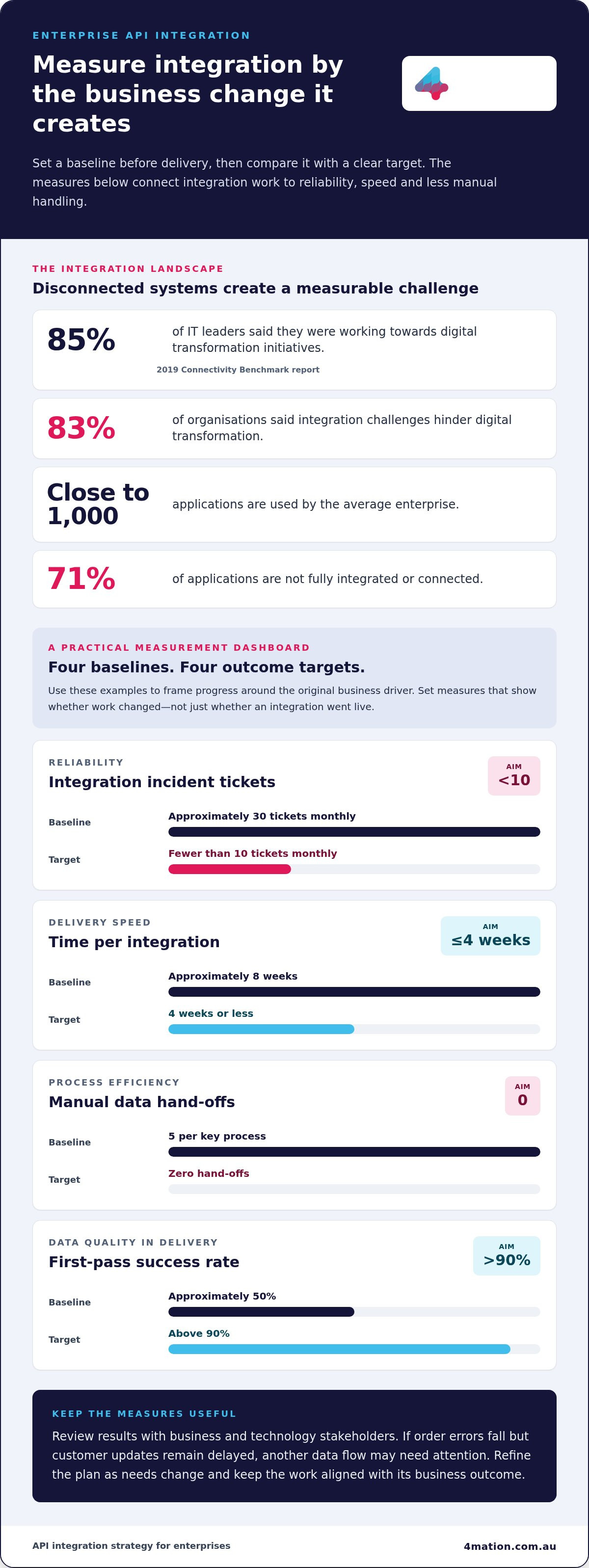
Enterprise priorities often include efficiency, customer experience and growth. In the 2019 Connectivity Benchmark report, 85% of IT leaders said they were working towards digital transformation initiatives. Integration challenges hinder digital transformation for 83% of organisations. These figures highlight why an API integration strategy for enterprises should connect delivery plans to business drivers, rather than focus only on technical convenience.
Disconnected applications can also limit agility. The average enterprise uses close to 1,000 applications, while 71% of applications are not fully integrated or connected. A useful first step is to map key systems, data sources and dependencies. That map helps identify where a connection could remove a manual hand-off, support faster service or enable a new digital capability.
Common risks include unclear objectives, poorly understood system dependencies, inconsistent data and integrations designed around isolated technical needs. These problems can cause rework, unreliable information and fragile connections that are difficult to change as business processes evolve.
Measure success against the original business driver. Track integration costs, reliability through incident volumes, and delivery time against a baseline; one example sets a baseline of approximately 30 integration incident tickets monthly and targets fewer than 10. Another compares approximately eight weeks per integration with a target of four weeks or less.
Choose measures that show whether the integration changed work, not just whether it went live. For an order process, track manual hand-offs and first-pass success. A stated baseline is five manual data hand-offs per key process, with a target of zero. Another example sets an integration first-pass success-rate baseline of approximately 50% and a target above 90%.
Review these measures regularly with business and technology stakeholders. If order errors fall but customer updates remain delayed, another data flow may need attention. Regular reviews help teams refine objectives, respond to changing needs and keep integration work aligned with business outcomes.
2. Security, timeliness and data-volume considerations
Before designing an integration, map your existing architecture, system dependencies and data flows. Trace a business process, such as a customer order, from its source system through fulfilment and reporting. Record which applications create, transform and consume each data field. This reveals where sensitive information moves, where delays occur and which systems a change could affect.
Match security controls to each flow’s exposure and purpose. Use authentication to verify which users or systems can access an API, and encryption to protect information in transit. TLS or SSL can secure transfers between APIs and clients. Apply throttling to limit requests during a spike and help prevent one integration from overwhelming a core system.
Review third-party APIs as carefully as internal connections. Assess the provider’s security practices, the information it receives and how failures could affect your operations. OWASP-based security assessments and penetration tests can help identify vulnerabilities before deployment. Keep access permissions narrow and document which system owns each data field.
The required data timeliness depends on the business process. A live delivery update may need near-immediate exchange, while an overnight reporting feed can tolerate a delay. Define acceptable data freshness, then select a flow that meets it. Monitoring response times and failed requests helps teams find bottlenecks before users experience disruption.
Data volume also shapes the design. A connection that handles routine records may behave differently during a bulk import or seasonal peak. Estimate request patterns based on business processes, then test representative loads. Throttling can protect core systems, while clear limits and error handling help connected applications respond predictably when capacity is reached.
AI data orchestration requires particular care because model outputs depend on the information supplied. Identify approved sources, define who can access them and set rules for checking data quality before it reaches an AI workflow. Governance should also clarify ownership, permitted use and how teams handle missing or inconsistent records. These steps support useful outputs while keeping accountability clear.
Validate data when it enters an integration and again before another application relies on it. For example, check that an order contains a recognised product identifier and a valid delivery address. Reject or quarantine records that fail validation instead of passing incorrect values downstream. Document field mappings, error responses and responsible system owners.
Review security and performance as systems change. A new application, data source or usage pattern can alter dependencies and exposure. Schedule regular checks of access, encryption, validation results and incident trends. If you’re assessing how these controls fit your systems, you can discuss your integration requirements.
3. Choosing API gateways, API management products and ESB platforms
An API gateway manages traffic entering or leaving APIs. It can apply access controls, route requests and enforce throttling. An enterprise service bus (ESB) connects applications through shared integration services, often transforming data between systems. API management covers a broader lifecycle, including API design, publication, monitoring and retirement. These tools have related but distinct roles, so match their capabilities to a real integration need.
Define your requirements before comparing products. Check compatibility with existing applications, security controls, scalability, monitoring, developer usability and support for your chosen standards. Earlier, organisations faced a choice of 2 or 3 core API integration products; the current choice is 20 or 30. A clear requirements list helps narrow that field and avoids paying for capabilities your ecosystem won’t use.
There is no single fixed cost for enterprise API management platforms or iPaaS tools in Australia. Pricing depends on the project and is provided after a quote request. Factors such as deployment model, usage, API volume, support and required integrations can affect the cost.
Deliver APIs incrementally, treating each as a product with users and measurable value. Rather than planning to develop 10 APIs over a year as one large batch, prioritise APIs around business initiatives and release them across multiple sprints. For example, deliver an order-status API first, gather feedback from customer service teams, then refine its data and documentation before expanding its use.
With a headless website, the front end is separate from the content management platform behind it. APIs can deliver content to different applications, such as a website and mobile app, without tying each experience to one presentation layer. This can help customer-facing channels evolve while retaining a central content source.
Set governance rules for who designs, approves, publishes and retires APIs. Define versioning conventions, documentation requirements and ownership before teams create connections. Keep documentation accessible and current, and record changes that could affect existing users. API lifecycle management gives teams a consistent path from proposal to retirement, reducing duplication and making changes easier to coordinate.
Centralised API management gives an organisation a shared view of its APIs and can simplify their development, security, deployment and monitoring. Yet centralisation works best with clear responsibilities: platform teams manage shared controls, while domain teams own the business meaning and quality of their data. 87% of organisations agree that API management could be improved, reinforcing the value of reviewing current practices.
Choose the simplest combination that meets current needs and supports planned growth. A gateway may suit controlled API access, while an ESB may fit complex connections across legacy systems. An API management platform can coordinate the wider lifecycle. Reassess these choices as business priorities and integration opportunities evolve.
4. Selecting architecture and integration standards
Architecture determines how applications connect, where business rules sit and how easily teams can change systems. An API-forward approach exposes agreed capabilities through interfaces rather than relying on tightly coupled, point-to-point connections. The practical benefit for executives is that teams can improve one application without requiring every connected system to change at once.
Start by classifying APIs according to their role. Domain APIs represent business capabilities, such as customer or order information. Data APIs provide controlled access to shared records, while experience APIs shape information for a particular channel, such as a mobile app. This taxonomy helps teams find suitable services, reduce duplicate logic and assign ownership to the right domain.
Choose an architecture based on what each flow needs to do. A synchronous request suits an application that needs an immediate answer, such as checking an account balance. An asynchronous API can handle a background task while keeping application resources available for new requests. Choose the pattern that fits the user experience and processing needs, not just the one a team knows best.
Open standards can make connections easier to document and maintain across platforms. The OpenAPI Specification is language- and platform-agnostic, allowing teams to describe an API contract without tying it to one programming language. If your organisation adopts OpenAPI as its contract standard, choose integration technology that supports it.
Set consistent design standards before teams build APIs. Define naming, data formats, error responses, authentication expectations and versioning conventions. For example, a customer API should use consistent field names across channels so a mobile application and service portal interpret customer details in the same way. Document the rules where developers can apply them during design and testing.
Versioning protects existing API users when an interface changes. Plan how to introduce a new version, communicate changes and retire an older one. Keep documentation aligned with the active interface, and identify which applications depend on each version. This lets delivery teams improve capabilities without unexpectedly disrupting the customer experience.
Account for innovation and future connections in architecture decisions. Keep business rules in the appropriate domain instead of copying them into every integration. Apply a search-first policy as the ecosystem grows, so teams can reuse an existing API before creating another. This makes the landscape easier to understand and reduces conflicting versions of the same business logic.
Review standards as business needs evolve. A new digital channel or application may require a different API composition, while existing contracts should remain stable where possible. Regular architecture reviews help technology and business leaders balance reuse, delivery speed and the flexibility to support new services.
5. API integration planning and implementation
Turn an integration strategy into a delivery roadmap by linking each connection to a business process. Start with a system inventory, process owner and desired outcome for each opportunity. For example, document how an order moves from an online store to warehouse processing, then identify the systems and teams affected by the change.
Sequence work so reusable foundations are in place before connections expand. The roadmap recommends implementing the core platform and Data APIs first. This helps secure the perimeter and begin decoupling systems. Data APIs provide controlled access to shared information, giving later integrations a consistent way to retrieve it.
Next, introduce Domain APIs and apply a search-first policy as the ecosystem grows. Domain APIs represent business capabilities, such as orders or customer records. Before creating a connection, teams search existing APIs for a suitable service. This reduces duplicate logic and helps keep business rules within the domain that owns them.
Plan migration alongside new delivery. Legacy direct connections can preserve important workflows, so map their dependencies and identify a replacement path before switching them off. The roadmap calls for completing legacy migration by shutting down those direct connections. A staged transition lets teams test replacement flows and address issues before removing the old route.
Deliver in increments tied to business initiatives. For an order process, start with the data needed to confirm an order, then add warehouse and shipping updates in later releases. Test each change with the people who use the process. This keeps delivery focused on usable outcomes and gives the team feedback before the integration expands.
Build operational readiness into implementation. Keep API documentation clear, current and accessible, and record which applications rely on each connection. Design integrations to handle exceptions gracefully, with meaningful error messages that help teams locate failures. For example, an unavailable carrier service should produce a traceable status, not a silent failure in order processing.
Choose implementation methods to suit team capacity and system complexity. An iPaaS platform can provide code-free integration for businesses without extensive IT resources. For a bespoke workflow, a custom-built connection may offer greater control over business logic. In either case, read each API’s documentation and maintain a record of the APIs in use.
Plan for performance after launch, not just during testing. Caching responses to common API calls can reduce repeated processing and resource use during high demand. Monitor usage patterns and bottlenecks, then refine the flow as volumes or business requirements change. Ongoing review supports digital transformation while preserving the ability to adapt the wider integration landscape.
For a practical roadmap, identify the first business process, its system owners and the dependencies that need addressing. Discuss your API integration roadmap with a technology partner.
4Mation: Custom Software Development
4mation can help when your integration requirements call for software designed around your systems and business processes. Through Custom Software Development, we work with you to understand the applications involved, define the desired data flows and shape an implementation approach that fits your goals.
A tailored integration is a practical option when off-the-shelf connections do not support a required workflow, or when legacy systems need to work alongside newer applications. A custom solution can connect those systems while keeping operational needs and users in view. The right scope depends on your architecture, data requirements and priorities.
If you’re planning an integration or need a clearer path from strategy to delivery, contact 4mation to discuss your requirements.
Turn your integration plan into lasting capability
Connected systems can support more than current workflows. As your business changes, they can give teams a stronger foundation for adapting services and building new digital experiences. Keep future priorities in view as you refine your API integration strategy for enterprises, so each decision supports your organisation’s direction.
The next step is to identify the opportunity that matters most to your team and define what progress would look like. A focused conversation can help turn that priority into a practical direction for your organisation.
Start a conversation about your technology priorities with 4mation and take the next step with clarity.
Frequently Asked Questions
How does API integration work?
An API exchange usually follows a defined sequence: an application sends a request, the receiving service checks it and returns a response. For example, a leave-management application could submit an approved absence to a rostering system. The response tells the sending application whether the update succeeded or needs attention. Decide how to handle timeouts, duplicate requests and partial failures before enabling the exchange.
What does it mean to be API-driven?
Being API-driven means treating APIs as maintained business assets, not one-off technical connections. Teams define who owns each API, who may use it and how changes are communicated. For example, a product team might publish an approved customer capability for several internal applications. Clear ownership and a catalogue help staff find and reuse that capability instead of building an overlapping solution.
Why is API integration important for businesses?
Integrations can make business processes easier to adapt when teams, services or customer expectations change. For example, a support team may need a consolidated view of a customer’s service history while the records remain in separate platforms. An integration can bring that view into the team’s workflow. The value is greatest when it removes a specific operational obstacle or enables a useful service improvement.
What is an enterprise API integration strategy?
An API integration strategy is a practical set of decisions guiding how an organisation prioritises, designs and manages integrations. Useful strategy artefacts include a prioritised backlog, ownership model, design principles, risk register and measures for each initiative. For example, a CIO can compare a customer-service improvement with a finance-system upgrade, then sequence work according to business value and dependencies.
How do you assess enterprise API integration requirements and existing systems?
Begin by collecting system owners, vendor documentation, interface details and known constraints. Check which applications have supported test environments, how changes are released and whether teams can access the expertise needed to maintain each connection. A workshop with business users can reveal exceptions that technical inventories miss, such as approvals or alternate workflows. Record these findings before selecting a delivery approach.
How do you choose between REST, GraphQL, gRPC and event-driven APIs for enterprise integration?
Choose an API style to match the consumer and workload. REST can suit broadly accessible web services, while GraphQL can help a client request a tailored set of fields. gRPC may fit service-to-service communication where teams need a strongly defined contract. Event-driven APIs suit reactions to changes that do not need an immediate response. Check platform support, developer skills and operational tools before standardising.
What are the best enterprise integration architecture patterns: point-to-point, ESB, iPaaS or API gateway?
The right fit depends on how your organisation expects integrations to change. A small, stable connection may not justify a shared platform. A broader programme may benefit from central controls or managed connectors, provided teams can operate them effectively. Compare the effort to build, monitor and change each option, including how failures are diagnosed. Avoid choosing a pattern solely because it is familiar or popular.
What security and compliance controls should enterprise APIs use in Australia, including the Australian Privacy Principles?
For Australian operations, assess each integration against your organisation’s privacy obligations, including relevant Australian Privacy Principles. Document why personal information is used, which fields are necessary, who can access them and how exceptions are handled. Keep evidence of design decisions, approvals and access reviews. Involve privacy and security teams early, especially when an integration changes the purpose, audience or systems handling personal information.