
Article
Bespoke Software: Understand Costs, Security and Industry Uses
A system designed around your business can cost more to build but less to work around. Bespoke software solutions are developed to meet an…
Jowena Borral · Software development · 4 November 2026

A system designed around your business can cost more to build but less to work around. Bespoke software solutions are developed to meet an organisation’s specific requirements, rather than making every process fit a general-purpose product. Their long-term value depends on whether that operational fit, flexibility and industry-specific functionality justify the initial development and testing effort.
Off-the-shelf software can be a sensible choice when it meets your needs and can grow with your business. But if workarounds, disconnected systems or specialised requirements create friction, a tailored system may fit your operations better. The right choice depends on what the software needs to support, not just its purchase cost.
This article explains how bespoke software works, what affects its long-term costs and how industry-specific systems can support security and compliance. It also looks at where tailored systems are used and when an off-the-shelf option may be more practical.
Key Takeaways
Weigh a tailored system against off-the-shelf software by how well each supports your workflows, requirements and plans to scale.
Assess long-term cost by looking beyond the initial build to maintenance, integrations and the effort required to work around software gaps.
Consider how security can be built into development and how system design can support your organisation’s compliance needs.
Explore how industry-specific systems can streamline workflows, connect information and improve customer or staff experiences.
Use the article’s examples to judge when a bespoke approach could add value, and when adapting an existing tool may be more practical.
Table of Contents
What Is Bespoke Software?
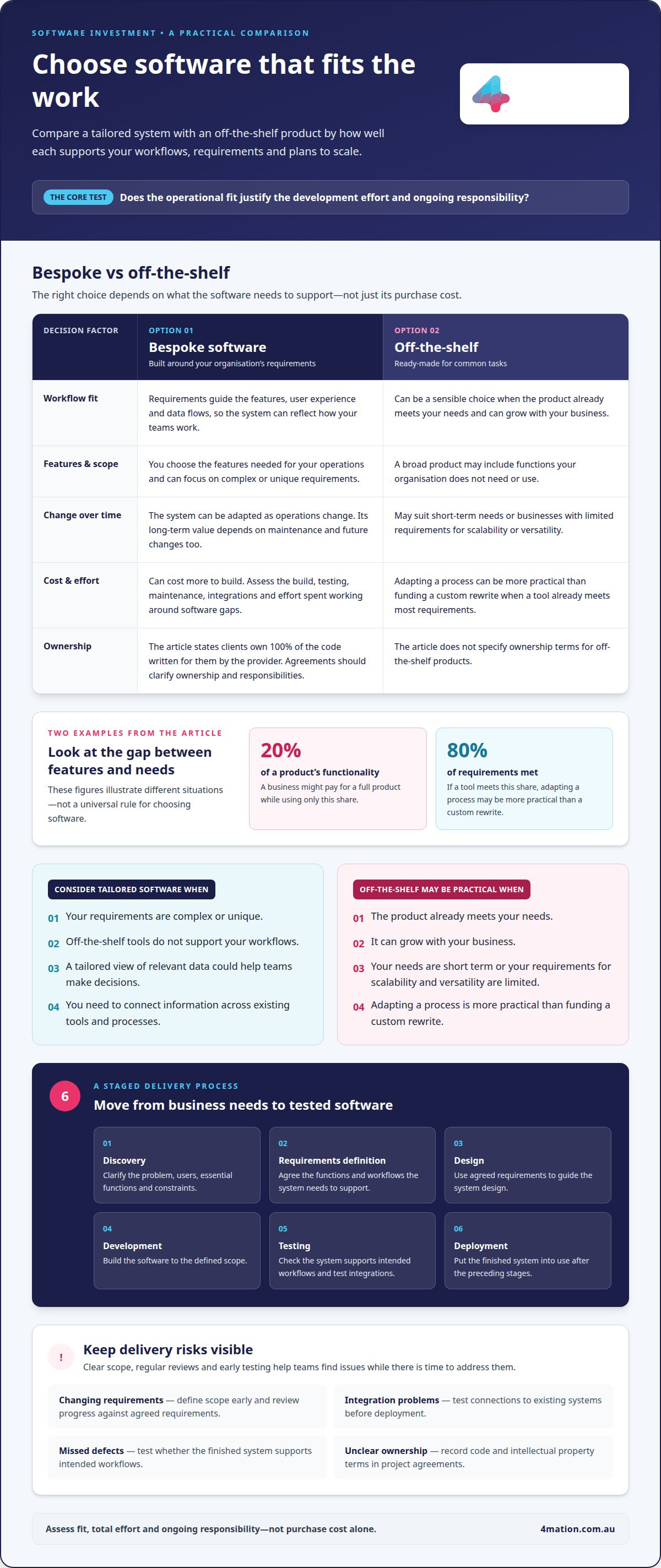
Bespoke software is built around an organisation’s specific requirements, rather than the needs of a broad market. The key decision is whether the operational fit justifies the development effort and ongoing responsibility.
Bespoke and Off-the-Shelf Software Compared
Off-the-shelf software is a ready-made product designed for common tasks, while bespoke software is developed for a particular organisation. This matters when a standard platform’s features don’t match your workflows. A business might pay for a full product while using only 20% of its functionality. Conversely, if a tool meets 80% of requirements, adapting a process can be more practical than funding a custom rewrite.
When choosing a bespoke software development company in Australia, assess how well it understands your operations, explains technical decisions and plans delivery, testing and ongoing support. Clear agreements about scope, responsibilities and intellectual property help keep the work aligned with your business priorities.
When Bespoke Software Is Preferable
Bespoke software may suit organisations with complex or unique requirements that off-the-shelf tools cannot meet. It lets you choose the features you need and adapt the system as operations change. For example, a sector-specific dashboard can bring relevant data into one view, helping teams make decisions using information that matters to their work.
Custom software development typically involves discovery, requirements definition, design, development, testing and deployment. Each stage informs the next: agreed requirements guide the design, and testing checks whether the finished system supports the intended workflows. This staged approach helps teams find gaps before they affect delivery.
Source Code and Intellectual Property Ownership
In a bespoke project, clients own 100% of the code written for them by the provider. That ownership can matter when you plan to maintain, extend or integrate the system over time. Project agreements should set out how ownership applies to the delivered code and related intellectual property, so responsibilities are clear when the work is complete.
Common project risks include changing requirements, integration problems, missed defects and unclear ownership. Teams can reduce these risks by defining scope early, reviewing progress against agreed requirements, testing integrations and recording decisions. For example, testing a connection to an existing customer system before deployment can reveal data or workflow issues while there is time to address them.
Off-the-shelf software can suit short-term needs or businesses with limited requirements for scalability or versatility.
Definition of bespoke software
Bespoke software is designed and built around an organisation’s defined requirements, rather than packaged for a broad market. Its scope reflects the work people need to complete, the information they use and the decisions the system must support. For example, a tailored platform might connect a company’s order process with its internal approval steps.
The definition covers more than writing code. Bespoke software development translates operational needs into agreed functions, user experiences and data flows. A project might specify which staff can approve a request, what information each person sees and how the system records a completed action. These decisions determine how well the software fits daily work.
A useful way to understand the term is to consider what the system is built to do. A bespoke customer management system can centralise contact details, purchase history and communication preferences. An invoicing system can help manage invoice-related tasks. Each focuses on a defined business task, rather than including functions for every possible organisation.
Purpose: A customer portal gives customers a place to access information, submit requests and manage accounts.
Users: A content management system lets non-technical staff update website pages without programming knowledge.
Workflow: Bug-tracking software brings reports, task assignments and progress into one process.
Scope: A team selects the features needed for its operations instead of implementing every feature in a broad product.
These examples show that “bespoke” describes how well software fits its intended use, not a particular format. The finished system could be a web application, mobile app or internal platform. Its defining feature is that requirements guide what gets built. It can also connect with existing tools, so staff don’t have to transfer the same information between separate processes.
Before implementation, teams clarify the problem, users, essential functions and constraints. For example, a service team might map how a request moves from submission to assignment and completion. This helps separate essential functions from optional additions and gives designers and developers a shared reference for building and testing software against real work.
If you’re considering a tailored system, discuss your software requirements to explore how your processes and goals could shape its scope.
Long-term cost efficiency
The initial build is only one part of a bespoke system’s financial impact. Long-term value depends on how well it supports daily work, what it costs to maintain and how often the business needs changes. Software that removes repeated data entry may reduce staff effort, while a system that requires frequent workarounds can preserve hidden operating costs.
Project cost and delivery time depend on scope, feature complexity, integrations and the technology selected. A simple system can take a few months to deliver. Mid-range work with integrations often takes six to twelve months, while a large ERP replacement can take a year or more and use a phased rollout. The number of connections and the depth of each workflow affect the work involved.
Compare the full operating model, not just the development effort. An off-the-shelf tool may have recurring subscription costs, while a custom system needs planned maintenance, bug fixes and updates. Either option may also require staff training and integration work. For example, if a sales team exports customer records from one platform and manually re-enters them elsewhere, that process has an ongoing time cost.
Long-term efficiency improves when software fits existing processes and connects systems cleanly. A tailored invoicing platform could bring templates, payment status and reminders into one workflow, reducing separate administrative steps. However, features that teams rarely use add build and testing effort without necessarily improving business outcomes. A defined scope helps prioritise essential capabilities first.
Build: More complex functionality requires additional design, development and testing.
Integrations: Connecting customer, finance or inventory systems adds work and coordination.
Maintenance: Updates, bug fixes and security patches form part of the system’s ongoing operating needs.
Change: New business processes may require adjustments, so maintainable software can make future changes easier to manage.
To estimate a project’s likely cost and timeline, first define the business problem, users, essential features, integrations and delivery priorities. Then separate what must be ready for launch from enhancements that can follow. For example, an organisation could implement core order processing first, then add reporting once staff have adopted the main workflow. This staged approach clarifies scope and aligns delivery with operational priorities.
Assess expected benefits against costs over the system’s working life. Bespoke software is not automatically more economical: its value depends on whether improved processes, fewer workarounds and better integration justify the build and ongoing care. This comparison gives decision-makers a practical basis for choosing between adapting existing tools and investing in software designed around their operations.
Security and industry compliance
A platform can support security and compliance when its controls reflect how an organisation handles information and completes work. Bespoke design can include features such as encryption for valuable files and data. However, a tailored system isn’t automatically secure or compliant. Its protection depends on development choices, the information it stores and how people use it.
Security should be part of the software development lifecycle, not something added only before launch. A secure SDLC incorporates security principles throughout a project, helping teams identify and address potential issues early. For example, reviewing account access for a customer portal during design can surface risks before the portal reaches users.
Industry requirements often affect the workflows a system needs to support. Consider a CRM used by 40 field engineers who need compliance sign-off for each visit. The system could record the required sign-off as part of the visit workflow, giving staff a consistent process and the organisation a clearer record. The design needs to reflect the actual process, not just store a generic customer note.
Access: Define which roles can view or change sensitive records, such as customer contact details.
Data: Identify the files and information the platform handles, then design suitable protections.
Workflows: Build required reviews or sign-offs into the steps staff follow.
Maintenance: Agree who applies security patches and how updates are managed after release.
Ongoing security depends on clear ownership after deployment. For a bespoke content management system, agree who will apply security patches quarterly. That responsibility should fit the organisation’s support arrangements and include a way to manage updates without disrupting essential publishing workflows. A named owner and defined process help prevent maintenance tasks from being overlooked.
Compliance also depends on how the system supports evidence and oversight. For example, a platform can record a field engineer’s sign-off against the relevant visit, rather than leaving it in a separate email. This makes the workflow easier to follow and review. The system should reflect the organisation’s applicable obligations and procedures; software alone doesn’t determine whether those obligations are met.
When scoping a system, teams can map sensitive information, user roles, approval steps and maintenance responsibilities, then incorporate them into technical design and testing. For example, testing a sign-off workflow with representative user roles can reveal whether the right people can complete and review each step. This connects security decisions with day-to-day operations.
Types and industry applications of bespoke systems
Bespoke systems take different forms because industries organise work in different ways. A manufacturer managing 10,000 spare parts may need a content management system that helps staff organise product information. A trade supplier serving 200 garages may need e-commerce software with negotiated, account-specific price lists. These examples show how system design can reflect the detail of a particular business model.
Business process automation systems coordinate tasks and reduce repetitive work. For example, a service business could use a tailored workflow to route incoming requests, assign tasks and track progress. Each step can reflect how the organisation handles work. Teams can prioritise parts of a process that cause delays, rather than automating tasks that already run smoothly.
Customer-facing portals give users a direct way to interact with an organisation. A customer portal might let people access service information, submit requests and manage account details. A training provider, for example, could present relevant information and request forms in one place. Its value depends on connecting user needs with internal processes, so requests reach the right team for action.
E-commerce systems bring product information, inventory, orders and customer data together. For the supplier serving 200 garages, account-specific price lists can support established trading relationships while keeping ordering within a central platform. A manufacturer might instead prioritise detailed spare-parts information and product discovery. The relevant features depend on what customers need to find and what staff must manage behind the scenes.
Automation: Routes approvals or service requests through defined business workflows.
Customer portals: Let customers find information, submit requests and manage accounts.
E-commerce platforms: Coordinate inventory, order processing and customer information.
Industry-specific content systems: Organise detailed catalogues, such as a manufacturer’s spare-parts range.
To identify the right system type, start with the operational bottleneck or customer task. A manufacturer may need faster access to parts information, while a trade supplier may need an ordering process that reflects negotiated customer terms. Mapping those needs to system functions focuses investment on practical benefits, rather than features that add complexity without improving the workflow.
If a specific workflow or customer interaction is holding your business back, discuss a tailored software project and the system requirements behind it.
4Mation: Custom Software Development
4mation works with you to shape custom software around your business goals, users and operational requirements. We help when existing tools create workarounds, disconnect important information or cannot support the workflows your organisation needs.
Our Custom Software Development service covers the design and development of systems tailored to specific requirements. Depending on the use case, this may include a web application, mobile app or AI implementation. Together, we clarify the problem, define the system’s scope and plan an approach that fits your operations without adding unnecessary complexity.
If you’re considering a tailored system, contact 4mation to discuss your business needs.
Shape your next software decision
The next step is to turn a broad technology ambition into a clear business priority. Identify the workflow that needs to change, the people who rely on it and the outcome you want to achieve. This focus helps determine whether bespoke software solutions are the right investment and what a useful first release should include.
4mation can work with you on the technical approach, from custom software development to AI consulting and implementation or mobile app development. The right starting point depends on the problem you need to solve, not on adding technology for its own sake.
Share your goals and current challenges with 4mation to explore a practical path forward. Discuss your software needs with 4mation and take the next step with clarity.
Frequently Asked Questions
What if the original developer leaves?
Continuity depends on making software understandable and accessible beyond its original developer. Use shared code repositories, organisation-controlled accounts and documented release procedures, rather than relying on personal access. For example, a second team member should be able to find the current version and understand how a change moves into production. These practices reduce disruption if responsibilities change and make future maintenance easier to hand over.
What are bespoke software solutions?
The term describes software whose requirements are shaped around a particular organisation. It doesn’t, by itself, tell you whether the system is reliable, secure or easy to maintain. Those qualities depend on design and delivery decisions. For example, a project should define how the system will be tested, who can approve changes and how future enhancements will be prioritised. These details help you assess the finished product beyond its “bespoke” label.
What are the benefits and drawbacks of bespoke software compared with off-the-shelf software?
A key consideration is who guides the product roadmap after launch. With a bespoke system, your organisation can prioritise changes around its business direction, but it must also decide what those changes should be. A standard product’s vendor manages its roadmap. If your operating model changes, consider how each option would accommodate that shift and who would choose the next improvements.
How much does custom software development cost in Australia?
The price depends on the case and is provided after a quote request. Before seeking an estimate, clarify the business outcome, decision-makers and boundaries of the proposed work. Record assumptions about existing systems and what success means for users. This gives the estimate a useful basis for discussion and helps decision-makers distinguish essential project work from later possibilities without treating an early estimate as a complete delivery plan.
What Australian privacy, cybersecurity and data protection rules apply to custom software?
The rules relevant to a system depend on your organisation, sector and data-handling activities. For example, a platform processing staff records raises different questions from one handling customer account information. Map what information enters the system, who can access it, where it moves and how long it remains useful. This helps identify which Australian privacy, cybersecurity and data protection obligations apply, and which controls to consider during design and operation.
What ongoing maintenance and support does bespoke software require?
Maintenance also involves deciding how proposed changes are assessed and released. A business owner can prioritise requests, while technical reviewers assess how each change affects existing functions. For example, changing a customer form may affect reports that use its submitted information. A planned release process helps teams consider those connections before making changes, keeping software development aligned with business priorities and reducing avoidable disruption to staff.
Which Australian businesses benefit most from bespoke software solutions?
Businesses with workflows spanning teams, locations or customer groups may find tailored systems useful. For example, an organisation coordinating service requests across branches could need consistent reporting while allowing each team to manage its local work. The case is strongest when there is a clear operational objective and the people involved can explain what better performance means. This gives the project a practical measure of value beyond simply replacing an older tool.