
Article
Custom Healthcare Software Solutions for Providers
Custom healthcare software can cost 5-10 times more upfront than implementing SaaS, but the upfront figure isn’t the whole investment. Custom…
Jowena Borral · Software development · 6 November 2026

Custom healthcare software can cost 5-10 times more upfront than implementing SaaS, but the upfront figure isn’t the whole investment. Custom healthcare software solutions can be built around a provider’s workflows and systems, while SaaS offers a ready-made starting point. The better fit depends on how closely existing products meet your needs and what each option will require over time.
It’s reasonable to weigh a tailored system’s flexibility against the lower initial commitment of a subscription product. The choice also affects how patient information moves between systems, how privacy requirements are addressed and what ongoing maintenance involves.
This article compares custom development with SaaS across cost, integration, compliance, implementation and support in the Australian healthcare context. You’ll see what shapes the investment, where a tailored solution can make sense, and how to assess the trade-offs before choosing an approach.
Key Takeaways
Custom development can involve a much higher upfront investment than SaaS, so compare the total cost of ownership over time, not just the initial commitment.
Map clinical workflows and data needs before deciding whether a tailored system or an existing SaaS product is the better fit.
Plan security, privacy and relevant Australian healthcare requirements into the solution from the start.
Assess how the software will connect with existing systems, especially where legacy platforms shape day-to-day operations.
Include implementation, ongoing maintenance and support in your investment planning to keep the software reliable as needs change.
Table of Contents
Healthcare software development services and outsourcing
Custom healthcare software solutions are applications designed around a provider’s patient data needs and clinical workflows. Australian providers should prioritise features that support those processes, connect systems through APIs and protect patient information.
Custom Software Types and Features
Applications can support patient administration, clinical workflows or a specific service such as remote consultations. The right type depends on where existing processes cause delays or duplicate work. For example, a provider might need a web application for staff workflows or a mobile app for patient access.
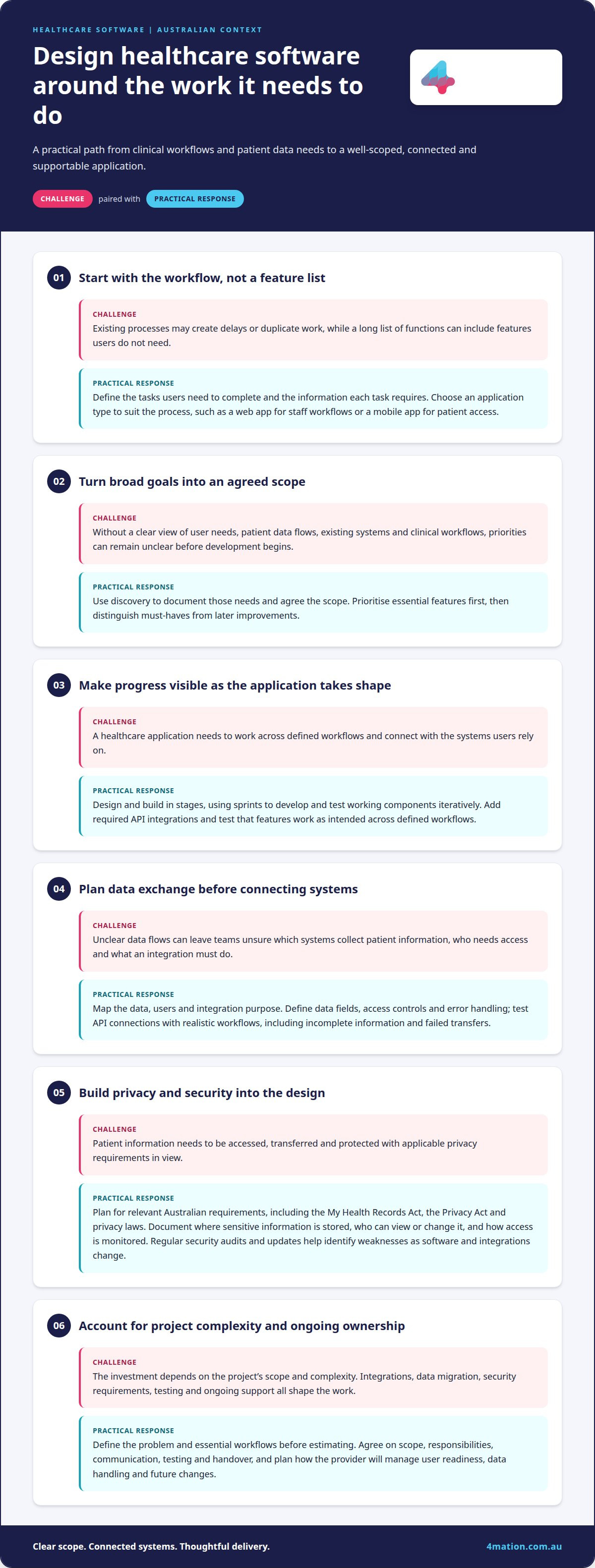
Start with the tasks users need to complete, then define the information each task requires. Features should fit the provider’s processes, give authorised users access to relevant patient information and connect with other systems through APIs where needed. This keeps the software focused on operational needs rather than a long list of unused functions.
Development Stages
A structured healthcare software development process begins with discovery. The team documents user needs, patient data flows, existing systems and the clinical workflows the application must support. This turns broad goals into an agreed scope, helping the provider prioritise essential features before development begins.
Next, the team designs and builds the application in stages, using sprints to develop and test working components iteratively. API integrations connect required systems, while testing checks that features work as intended across defined workflows. Before release, the implementation plan should address user readiness, data handling and how the provider will manage ongoing changes.
Choosing a Development Partner
Assess a partner’s approach to healthcare processes, application development, API integration and testing. Ask how the team will document requirements, manage changes and demonstrate progress through working software. A clear delivery plan should show who makes decisions, how issues are escalated and how clinical and operational users contribute at each stage.
Outsourcing can add development capability without requiring every technical role in-house. The arrangement still needs clear ownership: agree on scope, responsibilities, communication, testing and handover. Review how the partner will document integrations and support future changes, so your team understands how the application fits into its wider systems.
Healthcare Software Costs in Australia
Healthcare software development costs in Australia depend on scope and complexity. A focused application with a small number of workflows differs from an enterprise platform with multiple user groups, integrations and testing needs. API work, data migration, security requirements and ongoing support also shape the overall investment.
For this development service, pricing depends on the project and is provided after a quote request; the scope, integrations, testing and support requirements help determine it. Define the problem and essential workflows first, then separate must-have features from later improvements. That gives the project team a practical basis for estimating the work without paying to build functions users may not need.
Security, interoperability and regulatory compliance
Security and interoperability need to be built into healthcare software from the outset. For Australian providers, that means planning how electronic health information is accessed, transferred and protected, while accounting for applicable privacy requirements. A clear design helps authorised staff use information efficiently without creating disconnected records or unnecessary exposure.
Start by mapping the data. Identify which systems collect patient information, which users need access and what each integration must do. For example, an application that sends appointment details to another platform needs defined data fields, access controls and error handling. Test API connections against realistic workflows, including incomplete information and failed transfers, so problems are visible before they affect daily operations.
The My Health Records Act, the Privacy Act and privacy laws are relevant to Australia’s healthcare sector. Their implications should inform requirements, system design and security reviews. For a practical development process, document where sensitive information is stored, who can view or change it, and how access is monitored. Regular security audits and updates help teams identify weaknesses as the software and its integrations change.
HIPAA alignment may also matter when a project supports US-based partners or workflows. Treat it as a separate design consideration, not a substitute for Australian requirements. Define the intended users, locations and data flows first, then map the controls needed for each context. This avoids assuming one framework automatically addresses every privacy or security obligation.
Some healthcare software may fall within Software as a Medical Device (SaMD). Where that applies, IEC 62304 software lifecycle processes may be relevant; ISO 13485 certification may also be a possible requirement. The project team should identify the software’s intended purpose early, since that shapes risk management, documentation and testing. These considerations are specific to regulated software, not every clinical application.
Blockchain may be considered for recording data exchanges or supporting traceability, but it does not replace access controls, secure system design or privacy planning. Assess whether the use case needs a shared, tamper-evident record before choosing that approach. For routine information sharing, a well-designed API integration may meet the operational need with less complexity.
For a healthcare software project, make security and interoperability deliverables explicit: data-flow documentation, access rules, integration tests and scheduled security reviews. If you’re planning a system that handles electronic patient information, discuss your project requirements as part of defining its technical and compliance scope.
Integration with healthcare systems and legacy platforms
Integration determines whether new software fits the systems healthcare providers already use. Map the information moving between platforms before development starts. For example, a patient appointment may need to appear in both a booking application and an electronic health record. Defining that flow clarifies which system owns each field and helps prevent duplicate entry. It also gives the team a practical way to assess whether the integration supports better patient care.
For electronic health record integration, document what information must move, when it should appear and which users need it. A clinician viewing a patient record may need relevant results from another system, while administration staff may need appointment updates. Specify how the application handles missing or conflicting information. These details help the development team design and test connections around real workflows, rather than assuming every platform stores information in the same way.
Legacy systems can make integration more challenging, particularly when healthcare organisations rely on older platforms. Begin by documenting available interfaces, data formats and the processes staff currently follow. If a legacy system cannot exchange information directly, the project may need an intermediate connection or a revised workflow. That decision should reflect the system’s role, the information involved and the impact of changing established processes.
Medical device software integration needs its own requirements. Identify what information the device produces, where staff need to see it and how the receiving application should respond to incomplete or delayed data. For example, a workflow may need device information displayed alongside a patient record. Define the connection and test it with representative scenarios before relying on it in daily operations. The device’s interface and intended use shape the integration approach.
Integration also affects reporting and analytics. Agree which system is the source for each data item, then define how updates flow into reports. For example, inconsistent patient identifiers across two platforms can make records harder to match. Test how the integration handles changed, repeated or incomplete information. Clear rules help users interpret reports and make operational decisions without assuming connected data is automatically consistent.
A practical integration plan records each system, its role, the data exchanged and the workflow it supports. The development team can then build connections incrementally, test complete user journeys and resolve issues before release. This makes integration decisions visible to technical and operational teams. If you’re planning connections across existing healthcare platforms, discuss your integration requirements as part of defining the project scope.
Healthcare software consulting, implementation and support
Consulting, implementation and support connect a software project to the clinical workflows it must serve. Begin by mapping how staff work, where patient data enters and which handovers cause delays. For example, a clinic may need appointment information available to reception and clinicians without repeated entry. This discovery gives the project team a practical basis for defining scope, prioritising functions and planning staff engagement.
Implementation should prepare people and processes alongside the software. The team can release a defined set of functions, train users on their regular tasks and collect feedback from clinical and administration staff. For example, a rollout plan might cover appointment booking first, then add reporting after users understand the initial workflow. Clear responsibilities for decisions, training and issue handling help teams manage change without leaving users uncertain about their next step.
Clinical decision support can present relevant information within a clinical workflow. For example, a system might display patient data or a reminder when a clinician reviews a record. The design should make the information clear, show its context and fit the decisions users need to make. Involving clinical users during design and testing helps the team assess whether prompts are useful, understandable and appropriate to the task.
Post-launch support keeps software aligned with changing operational needs. Maintenance includes regular updates, security patches and feature enhancements. A support plan should define how users report faults, how the team prioritises issues and how changes are tested before release. For example, an update to a patient intake form should be checked against the workflows that depend on its fields. This reduces avoidable disruption and helps preserve data quality.
Ongoing healthcare IT support also creates a path for continuous improvement. Teams can review recurring support requests, user feedback and workflow bottlenecks, then prioritise changes that address the underlying cause. Monitoring system performance and integration errors helps identify technical issues affecting daily processes. These reviews should distinguish urgent faults from planned enhancements, keeping maintenance connected to patient care and operational priorities.
Budget for maintenance as part of the software lifecycle, not as an afterthought. Ongoing work can include updates, security patches, troubleshooting and enhancements as workflows evolve. The workload depends on the system’s complexity, integrations and pace of change. Set review points and assign ownership for approving and testing changes, then communicate their impact to users.
When planning implementation or ongoing support, define the clinical workflows, user engagement and maintenance responsibilities together. Discuss your software project requirements to map the delivery and support needs around your organisation.
Custom software investment and SaaS cost comparison
SaaS can provide healthcare applications with a lower initial commitment, while custom development requires more investment before launch. That difference reflects how each option is delivered: SaaS provides a ready-made product, while custom software is designed around defined workflows. The useful comparison is not simply the first invoice. It is whether the solution fits your operations and delivers value over its working life.
Start with the job the software must do. A clinic needing appointment bookings and remote consultations may find an existing SaaS application fits its requirements. A provider managing unusual referral processes or several connected platforms may need more tailored workflows. List the required tasks, users and integrations, then separate essential capabilities from features that would be useful but non-essential.
Compare the full cost categories for each option. For SaaS, include subscription charges, configuration, integration and any work needed to adapt processes. For custom development, consider discovery, application development, testing, deployment and ongoing maintenance. For example, a booking system that needs a link to patient records requires integration work under either model, even if the product itself is ready-made.
Ownership and change also affect the decision. A SaaS provider manages the product, but its roadmap may not match your preferred workflow or timing. Custom software gives your organisation greater control over planned changes, while making you responsible for maintaining the application. A software development partner should explain how scope, testing, handover and future updates are handled, so you can account for the complete lifecycle.
Assess how well each option can deliver your intended outcomes. If a standard application supports appointment management with minimal process changes, custom development may add complexity without enough operational value. If staff repeatedly re-enter information across platforms, a tailored integration may reduce that friction. Compare the workflow improvement with delivery effort, integration needs and ongoing ownership.
Use a consistent decision process:
Document the current process, including manual steps and system handovers.
Define the required outcomes, such as fewer duplicate entries or smoother remote bookings.
Map each SaaS option against required workflows, integrations and future changes.
Estimate the full lifecycle responsibilities for implementation, maintenance and support.
The strongest choice is the one that fits the work without paying for avoidable complexity. If SaaS meets your needs, it can be a practical route. If existing products leave important workflows unresolved, a custom approach may justify its greater upfront commitment. Discuss your healthcare software investment and the trade-offs shaping your project.
4Mation: Custom Software Development
4mation works with healthcare providers when existing applications don’t fit their workflows, integrations or plans for growth. Through Custom Software Development, we shape the project around your operational needs, from defining requirements to building and testing an application. Web Application Development or Mobile App Development can support different users and ways of working, while AI Consulting & Implementation can help assess relevant opportunities.
The next step is to clarify the problem, the users affected and the systems involved. Together, we can consider whether a tailored application addresses a genuine gap or whether another approach better fits your goals. If you’re considering a healthcare software project, contact 4mation to discuss your requirements.
Set your healthcare technology direction with confidence
The next step is to turn your preferred approach into a clear decision your team can act on. Identify the operational outcome that matters most, the users who need to benefit and the constraints that will shape delivery. This gives stakeholders a shared basis for deciding what to build, adopt or improve, and what success should look like in practice.
For providers weighing custom healthcare software solutions, the decision is not simply about choosing a technology. It is about making a considered investment that fits the organisation’s priorities and can adapt as those priorities change. A focused conversation can help clarify the problem, explore practical options and define a sensible starting point.
Discuss your healthcare software needs with 4mation and take the next step with a clear view of your goals. Thoughtful planning can make the path forward more manageable.
Frequently Asked Questions
How much does custom healthcare software development cost in Australia?
There is no single development cost for every Australian healthcare project. The investment depends on the application’s scope, workflow complexity, integrations, testing and ongoing support. Custom development can require a substantially higher upfront investment than SaaS, so compare the total responsibilities and costs across the software’s lifecycle. For a useful estimate, define the essential users, tasks and system connections before setting the project scope.
How long does it take to build custom healthcare software?
Delivery time is shaped by the amount of software to build, the number of workflows, integration complexity and testing needs. A focused application with clearly defined requirements involves different work from a platform connecting multiple systems. Decisions and feedback also affect progress. Agree on the first release’s essential functions and acceptance criteria early, so the team can organise development into manageable stages and assess each working component before launch.
What are the benefits and drawbacks of custom healthcare software versus off-the-shelf systems?
Custom software can match a provider’s specific workflows, while off-the-shelf systems offer established functions without building an application from scratch. The trade-off is ownership: a tailored system needs ongoing maintenance and planned updates. For example, a provider with a distinctive referral process may value a closer workflow fit, while another may find a standard booking application sufficient. The best choice depends on how well the product supports essential tasks.
What Australian privacy and data security laws apply to healthcare software?
Australia’s healthcare sector is governed by the Privacy Act, the My Health Records Act and relevant privacy laws. These are important considerations when software handles health information. Project teams should identify what patient data the application processes, where it moves, and who needs access. That information helps shape privacy and security requirements. The relevant obligations depend on the organisation, the information handled and how the software is used.
What steps are involved in planning, developing, testing and launching healthcare software?
Begin by defining the operational goal and the users who need the software. Document workflows, information requirements and system connections, then agree on scope and acceptance criteria. The development team designs and builds the application in stages, testing each function and integration against real tasks. Before launch, prepare user guidance, responsibilities and a release plan. After deployment, monitor issues and feedback to guide maintenance and prioritise improvements.
How should healthcare providers choose a custom software development company in Australia?
Choose a partner that can turn clinical and operational needs into a clear delivery plan. Look for a defined approach to requirements, integration testing, privacy considerations, decision-making and handover. Ask how progress will be demonstrated and how changes will be managed during development. For example, a project plan should identify who approves workflow changes and who accepts completed features. Those details make responsibilities visible before delivery begins.
What security, clinical safety and compliance risks should healthcare software address?
Key risks include inappropriate access to patient data, inaccurate information moving between systems, and software behaviour that disrupts a clinical workflow. Projects should define access controls, test data transfers and assess how users interpret prompts or displayed information. Software regulated as a medical device may involve additional lifecycle considerations, including IEC 62304 processes. Identify the application’s intended use early, then align testing and documentation with its role in patient care.