
Article
Enterprise Software Development in Sydney: Costs and Services
Enterprise software costs depend on what a system needs to connect, automate and support. Delivering enterprise software development in Sydney can…
Jowena Borral · Software development · 11 November 2026

Enterprise software costs depend on what a system needs to connect, automate and support. Delivering enterprise software development in Sydney can range from a focused business application to a complex platform linking existing systems, data and workflows.
It’s reasonable to want a clear view of the investment before committing. Requirements, integrations, data migration, security needs and ongoing support all shape the cost. A useful estimate starts with understanding the business problem and the outcome you need.
This guide explains what influences project costs, the services involved in enterprise software development and how 4mation delivers solutions for organisations operating in Sydney and across Australia. You’ll also learn how to assess the scope and delivery approach, so you can make a more informed decision about the software your organisation needs and the value it should deliver.
Key Takeaways
Understand which project factors shape a software budget, from integrations and data migration to security and ongoing support.
See how the Privacy Act 1988 and eligible data breach reporting requirements can inform software planning.
Identify the services that can support enterprise needs, including custom software, web applications, mobile apps and AI implementation.
Learn why a provider’s Sydney presence and broader office footprint can matter when planning delivery and collaboration.
Use practical criteria to assess an agency’s industry experience, delivery approach and fit with your organisation’s goals.
Table of Contents
How much does software development cost?
Software development costs depend on the work a platform must do, the systems it connects and the risks it must manage. A customer portal, for example, may need secure logins, account information and links to existing business systems. An industry-specific platform may also need specialised workflows, reporting or customer interactions.
Relevant industry experience helps a development team understand workflows before they lead to costly design changes. For example, appointment bookings and patient-facing functions shape the requirements for a healthcare solution. A logistics platform may need to support dispatch, tracking and information shared across operations. These examples show why experience matters, while recognising that every organisation’s needs differ.
Organisation size also affects requirements. A growing business may need one system to replace spreadsheets and manual handovers. A larger organisation may need integrations across departments, consistent reporting and a staged rollout. Define scope early by identifying who needs access, which processes the software must support and which existing systems it must connect.
Privacy requirements belong in that assessment. Organisations covered by the Privacy Act 1988 must comply with its obligations, including reporting eligible data breaches under the Notifiable Data Breaches scheme, according to the Federal Register of Legislation. The Office of the Australian Information Commissioner also explains that eligible data breaches must be reported under the scheme. Those obligations make data access, storage and incident handling important design considerations.
How do Sydney software development companies compare with in-house teams and offshore providers? A Sydney-based team can work locally with stakeholders, while an in-house team builds knowledge inside the organisation. Offshore providers may add distributed delivery capacity, but collaboration and coordination need deliberate planning.
To assess a provider’s fit, examine its industry experience and delivery examples. Ask how it approaches:
Industry workflows: Can the proposed platform support processes such as claims handling or stock management?
Integrations: Which business systems need to exchange information, and how will that flow work?
Growth: Can the solution adapt as users, services or operational needs change?
Privacy: How will access controls and data handling requirements shape the design?
For enterprise software development in Sydney, these factors help explain why two projects with similar features can have different scopes. Clear requirements, relevant sector knowledge and a considered integration plan provide a practical basis for estimating effort and making investment decisions.
Enterprise software development costs
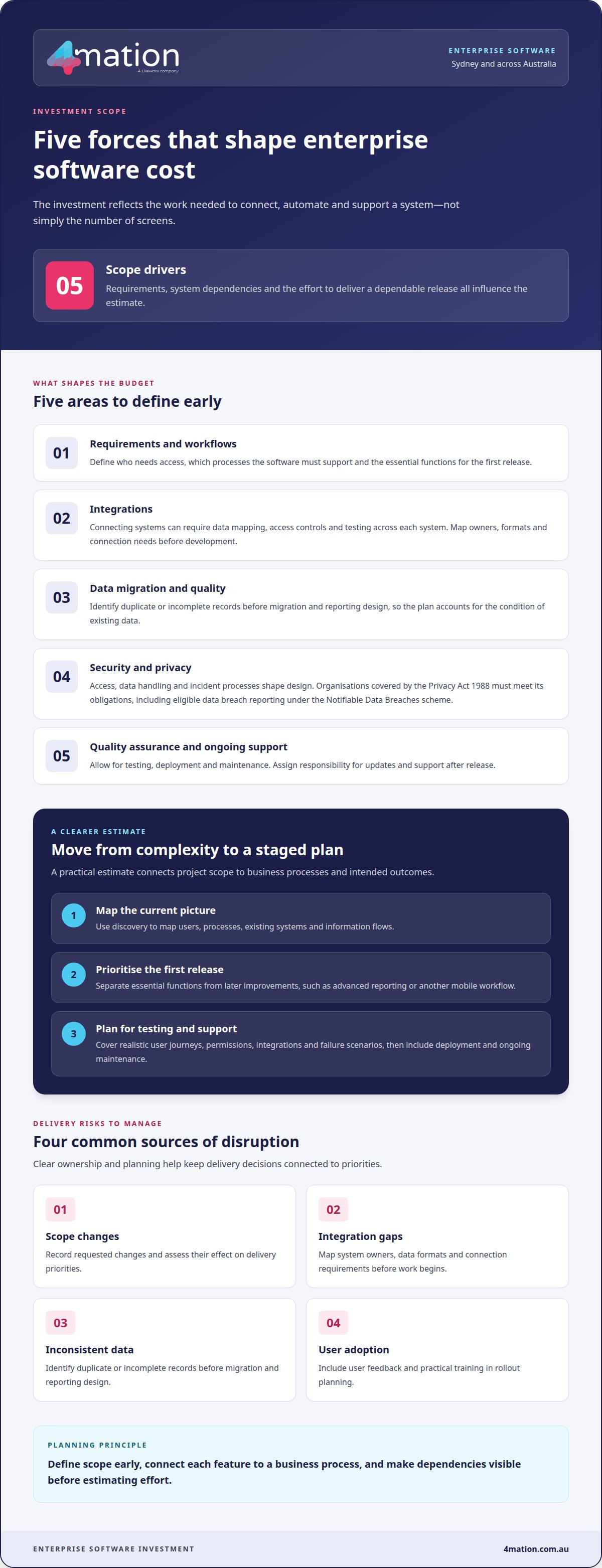
Enterprise project costs reflect the work needed to deliver a dependable system, not simply the number of screens. A secure platform with mobile access, government reporting and legacy integrations needs different planning from a standalone staff tool. Teams define scope by linking each feature to a business process and intended outcome.
Several decisions shape that scope. Connecting a customer portal to finance software, for example, requires data mapping, access controls and testing across both systems. Replacing manual approvals also means documenting current steps, handling exceptions and supporting staff through new workflows. Each dependency adds design, development or testing effort.
A practical estimate starts with discovery. The team maps users, processes, existing systems and information flows. It then separates essential functions from later improvements, such as advanced reporting or another mobile workflow. This staged plan helps decision-makers prioritise the core release while keeping future growth in view.
Delivery estimates should also include quality assurance, deployment and ongoing maintenance. Testing needs to cover realistic user journeys, permissions, integrations and failure scenarios. For instance, test a finance platform when an external service is unavailable, not only when every connection works. A secure release plan also assigns responsibility for updates and support.
What Australian privacy, cybersecurity and data-residency rules apply? Privacy requirements include the Privacy Act 1988 and the Notifiable Data Breaches scheme, explained above. Security controls should reflect the data and access model, while data locations need assessment against applicable sector, contract and government requirements.
What risks and common challenges affect enterprise projects in Sydney? Unclear scope, legacy integrations, inconsistent data and delayed stakeholder decisions can disrupt delivery. A project plan should assign owners, record dependencies and review risks at each milestone.
Scope changes: Record requested changes and assess their effects on delivery priorities.
Integration gaps: Map system owners, data formats and connection requirements before development starts.
Data quality: Identify duplicate or incomplete records before migration and reporting design.
Adoption: Include user feedback and practical training in rollout planning.
For example, a growing organisation might first release secure staff approvals, then add mobile access after validating the workflow. This reduces the risk of building features before teams understand how they will use them. Estimates become clearer when each release has defined acceptance criteria and accountable decision-makers.
A focused project scope discussion can help translate these dependencies into a structured delivery plan and prioritised requirements.
Enterprise software development services
Enterprise software services turn operational needs into technology that supports reliable day-to-day work. A booking platform, for example, can connect customer requests with staff schedules and payment records. The work may include planning, interface design, integrations, testing and ongoing improvement. Each activity should address a defined business need, not add complexity without purpose.
Architecture decisions shape how a system works with existing technology. A new application might need to exchange information with a customer relationship management system, finance platform or identity service. Mapping connections early helps teams understand data flows and dependencies. It also clarifies which systems will remain in place and which processes need adjustment before launch.
What are the steps in an enterprise software development project, from discovery to deployment? The team starts by understanding users, workflows and desired outcomes, then defines requirements and architecture. It builds and tests the software against agreed scenarios before preparing deployment, user guidance and ongoing support.
Discovery: Map the current process, such as how staff receive and approve service requests.
Requirements: Record user roles, business rules, data needs and essential features.
Architecture and design: Plan integrations, system structure and screen layouts around those requirements.
Development and testing: Build features, then test workflows, permissions and connections with existing systems.
Deployment and support: Release the platform in a planned sequence and address operational issues.
Web and mobile interfaces can give employees or customers access to the same underlying services. For instance, a field worker might submit a job update from a mobile device while an operations team reviews it on a web dashboard. Clear access rules and consistent information help each user complete relevant tasks.
Data migration is especially practical when spreadsheets or older applications hold essential records. Teams identify what information must move, define how fields correspond and test sample records before migration. This can reveal duplicates or missing values that might otherwise affect reports and business decisions.
After launch, support and improvement help keep software aligned with changing operations. A team can review user feedback, resolve defects and refine workflows as requirements evolve. For example, a service-request platform may add an approval step when responsibilities change. This keeps technology connected to business priorities, rather than treating launch as the end of the project.
Provider locations and office footprint
A provider’s office location can affect workshops, stakeholder access and day-to-day collaboration. A Sydney-based team may meet in person for process mapping, then continue reviews online. The useful measure is not a postcode alone, but how the delivery team works with your people throughout the project.
Sydney organisations may have teams across the CBD, Parramatta and North Sydney. If stakeholders work across several sites, plan sessions around the people who own each workflow. For example, operations staff can map a current approval process while technology leaders explain legacy system dependencies.
A delivery team may include local staff, interstate colleagues or international teams. Any arrangement can work when responsibilities and communication are clear. Ask which roles will contribute, where those people are based and who makes decisions. A named delivery lead helps keep actions, risks and feedback connected.
Distributed delivery needs a reliable way to share decisions. A team working across Sydney and another office can document requirements, record design choices and track issues in one agreed workspace. Regular demonstrations give users a practical way to respond to working software, rather than relying solely on written descriptions.
Location also matters during discovery. A provider that understands the operating context can observe how staff use existing tools, where manual handovers occur and which steps suit automation. For example, a site visit may reveal that two teams enter the same customer details into separate systems. That observation can shape integration priorities.
Before delivery begins, establish a simple collaboration rhythm. Confirm who attends workshops, how quickly stakeholders review decisions and where the team records feedback. If employees work across several Sydney locations, schedule sessions that include each affected group. This helps prevent a workflow designed around one office from overlooking another team’s needs.
Team footprint: Identify the delivery lead, specialists and decision-makers, including their locations.
Collaboration: Agree on workshop, demonstration and review formats that suit your staff.
Project records: Keep requirements, decisions and feedback accessible to relevant stakeholders.
Operational context: Include the teams who use legacy systems or handle manual processes.
A clear footprint supports practical collaboration, whether the work happens in a Sydney meeting room or online. Match the provider’s working model to your organisation’s locations, stakeholder availability and need for direct feedback. That gives the project a defined path for resolving questions and keeping delivery decisions grounded in real workflows.
Which Sydney agencies specialise in enterprise software development?
Sydney’s enterprise software agencies differ in the problems they solve. Some focus on bespoke platforms and integrations, while others specialise in mobile applications, data-heavy systems or industry workflows. The right fit depends on whether your priority is replacing legacy tools, connecting departments or improving customer access.
Start by matching an agency’s demonstrated work to your project. A logistics platform, for example, may need to coordinate dispatch, delivery updates and internal operations. A financial system may require carefully designed permissions, audit trails and connections to existing applications. Relevant examples show whether a team understands your operating context, not just software delivery in general.
Agency size alone does not establish suitability. A smaller team may provide direct access to delivery specialists, while a larger firm may offer a broader range of project roles. Either way, identify who will lead discovery, make architecture decisions, manage delivery and support the system after launch.
Review case studies for the original business challenge, the solution delivered and how it was used. Look for specifics such as a customer portal integrated with finance software or a staff application replacing paper-based approvals. Clear examples help distinguish hands-on enterprise delivery from broad claims about digital transformation.
Use a structured assessment to compare potential partners:
Relevant experience: Find examples involving similar users, workflows or integration requirements.
Delivery approach: Understand how discovery, design, development, testing and deployment connect.
Technical fit: Discuss how the proposed architecture will work with your existing systems.
Ongoing ownership: Clarify how support, fixes and future improvements will be handled.
A useful discussion starts with one business process. Describe how a request currently moves between teams, where delays occur and what information staff need. Then ask the agency how it would assess that workflow before recommending technology. The response should link proposed features to operational outcomes and identify key dependencies.
For enterprise software development in Sydney, local access can make workshops and stakeholder conversations easier to arrange. However, office location alone does not prove industry expertise or delivery quality. Evaluate the actual team, relevant examples and proposed working model against your requirements.
If you’re ready to discuss your project’s requirements and delivery priorities, start a conversation.
4Mation: Custom Software Development
4mation Technologies works with organisations that need software shaped around their business, users and operational goals. When disconnected systems, repetitive tasks or legacy applications limit progress, custom development can address the underlying process rather than add another generic tool. The focus is a solution that fits how your organisation works and can support its future direction.
We begin by understanding the challenge, the people affected and the outcome your organisation needs. Together, we clarify requirements, identify existing systems and define which capabilities matter first. For example, a business may need a web application that brings information from separate systems into one usable workflow. Early decisions keep delivery connected to operational priorities.
Our custom software development supports tailored business requirements across the software lifecycle. That may involve designing an application, building integrations or improving a platform as needs change. We also provide Web Application Development and Mobile App Development where staff or customers need practical access to business processes across devices.
Some opportunities call for a different capability. Our AI Consulting & Implementation service helps organisations assess where artificial intelligence can address a defined business need. We focus on the use case, its place in existing workflows and the information it depends on, keeping technology decisions grounded in practical outcomes rather than novelty.
4mation may be a suitable partner when your organisation needs to:
Replace manual steps with a purpose-built application or workflow.
Connect business systems that hold separate parts of a process.
Give employees or customers access through a web or mobile application.
Assess an AI use case and how it could support business operations.
For an enterprise project, we work with your stakeholders to set priorities and shape an approach around your requirements. That means discussing users, integrations, business rules and operational context before recommending a solution. You can bring an early concept, a defined project brief or a process that needs improvement. The discussion starts with what your organisation wants to achieve.
Custom development makes sense when standard workflows cannot meet important requirements or existing systems need to work together more effectively. If an established product already serves your needs, bespoke software may add unnecessary complexity. The right approach should match the business problem, not expand your technology footprint without purpose.
Contact 4mation to discuss your software requirements and business goals.
Turn your software priorities into a clear next step
The value of enterprise software development in Sydney comes from choosing a project that solves a real business problem and gives your teams a practical way forward. Before development begins, align stakeholders on the outcome, the users who need it and the operational change that would make a difference. That shared direction helps keep decisions focused as the work takes shape.
4mation can work with you on Custom Software Development when existing systems or workflows no longer fit your requirements. AI Consulting & Implementation can help assess a suitable business use case, while Mobile App Development can bring key processes to staff or customers on mobile devices. The right starting point depends on your organisation’s needs and priorities.
A useful first conversation can focus on the challenge you want to address, the systems involved and what success would look like. From there, explore a considered approach with a technology partner that understands both the business goal and the delivery work required.
Talk to 4mation about your project, and take the next step towards software that supports your goals.
Frequently Asked Questions
How long does it take to build software?
The timeframe depends on the features, integrations and review process. A focused application with one main user journey takes less work than a platform serving several departments. For example, an online booking tool may need fewer workflows than a system coordinating bookings, payments and staff access. Planning user feedback and decisions early helps the delivery team sequence work and keep requirements clear as development progresses.
Can you integrate with third-party applications?
Yes, software can integrate with third-party applications when those systems support a suitable connection method. An online store, for instance, might send order information to a finance platform, reducing duplicate entry. Integration planning considers what information needs to move, when updates happen and how errors are handled. These details help connected systems support the intended workflow without creating extra reconciliation work.
Why would a business choose custom software instead of off-the-shelf software?
Custom software can suit a business whose important workflows or rules do not fit standard products. For example, a service organisation with a distinctive approval process may need tailored user roles and handovers. A standard product may be more practical if its existing features meet the need. Weigh workflow fit, integration requirements, ongoing ownership and how much your organisation needs to adapt its processes.
What services do enterprise software companies offer?
Services can include discovery, software design, development, system integration, testing and post-launch support. Depending on the project, a provider may also deliver web applications, mobile applications or AI implementation. For example, an organisation could plan a staff portal, connect it with existing systems and maintain it after launch. The right mix depends on the business outcome and the work required.
How much does a custom enterprise system cost?
Scope and delivery requirements shape the investment. Integrations, data migration, user roles, security needs, testing and ongoing support all affect the work involved. A system connecting several departments requires different planning from a standalone application. A useful estimate starts with clear requirements and prioritised features, helping decision-makers understand what the project includes and how each component supports business needs.
What is the typical timeline for an enterprise software project in Australia?
A focused minimum viable product is estimated to take 3-4 months, while broader projects depend on scope and dependencies. Connecting legacy systems, preparing data and coordinating stakeholder groups can affect the schedule. Teams can plan a staged release by agreeing on essential first features, testing those workflows and scheduling later enhancements separately. This gives the organisation clearer delivery milestones without treating every project as identical.
What technologies and platforms do enterprise developers use?
Technology choices should match the users, business processes and existing systems. For instance, a web application can give office teams access to shared information, while a mobile app can support staff working away from their desks. The platform and integrations affect how information moves between tools. A development team should explain how each choice supports usability, security and operational needs.
How can a business assess a software development company?
Start by defining the business problem, users and systems the project must support. Then assess the delivery approach, including how requirements are documented, decisions are made and work is tested. A practical discussion might trace a customer request from submission to staff action. This helps establish whether the proposed solution addresses the real workflow, its dependencies and the outcome your organisation needs.