
Article
Fintech App Development in Sydney: Services, Process and Timing
A focused fintech app can take 3-6 months to develop, while a complex platform with deep compliance requirements may take 8-18 months. Fintech app…
Jowena Borral · Software development · 6 November 2026

A focused fintech app can take 3-6 months to develop, while a complex platform with deep compliance requirements may take 8-18 months. Fintech app development across Australia depends on the app’s scope, integrations, compliance needs and testing requirements, so a clear plan matters as much as the build itself.
Choosing a fintech app development partner in Sydney is a significant decision for businesses nationwide: your app needs to serve customers well while supporting the business processes behind every transaction. At 4mation, we guide founders and enterprises through this journey. This guide explains what custom fintech development can cover, how discovery, design, development, testing and deployment fit together, and what can affect delivery timing. It also outlines finance app options and Australian regulatory considerations to help you plan your next step.
Key Takeaways
Use the 3-6-month guide for a focused app and allow 8-18 months for a complex platform with deep compliance requirements. Scope and integrations shape the delivery plan.
Identify the fintech service your business needs, from mobile banking to personal finance tools, before deciding what to build.
Shape a custom app around your users, business processes and systems so the product supports practical outcomes, not just a feature list.
Build discovery, design, development, testing and deployment into one delivery process to manage risk and prepare for launch.
Understand how Australia’s regulatory environment may affect your plans. According to ASIC, the enhanced regulatory sandbox lets natural persons and businesses test certain innovative financial services or credit activities without first obtaining an AFS or credit licence.
Table of Contents
App development timelines
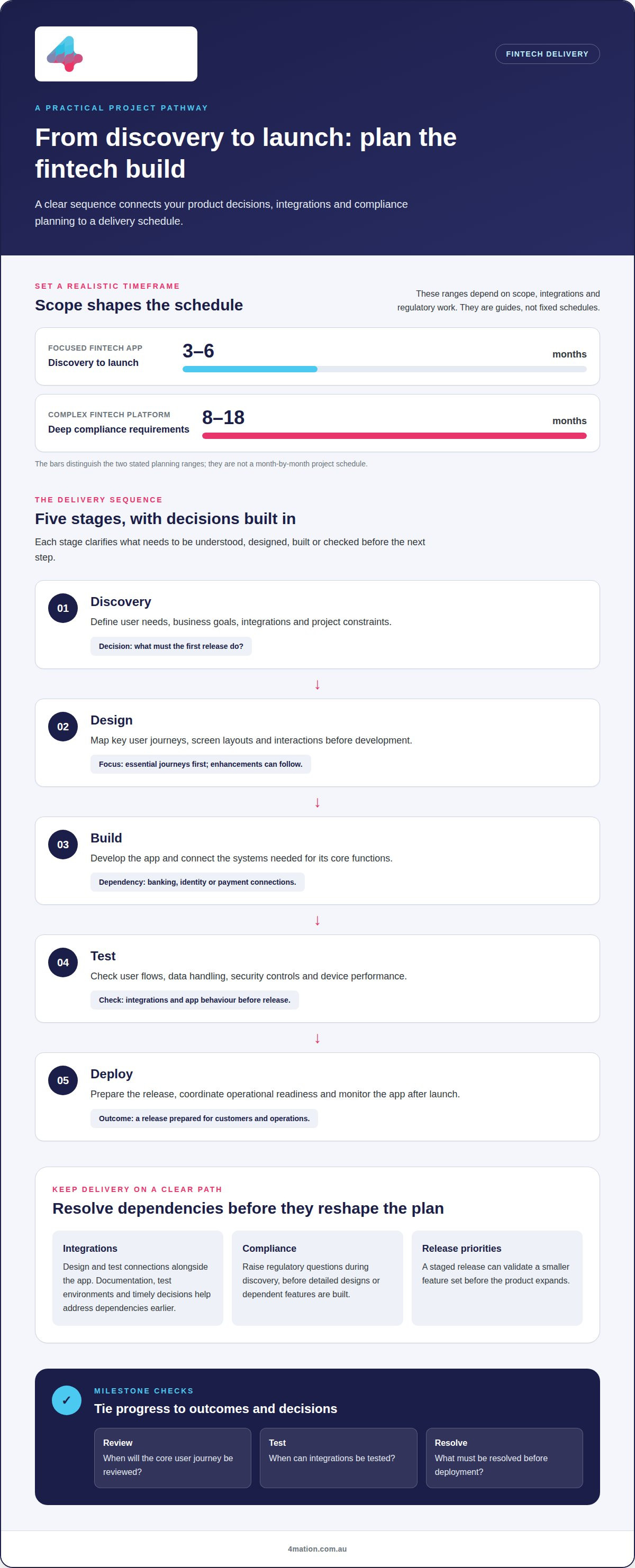
A focused fintech app typically takes 3-6 months to develop from discovery to launch. A complex fintech platform with deep compliance requirements may take 8-18 months. These ranges reflect different levels of scope, integration and regulatory work, rather than a fixed schedule for every project. A payment feature added to an existing platform, for example, has different delivery needs from a new service with several user roles and financial products.
Start by defining what the first release must do. Separate essential user journeys from enhancements that can come later. For a personal finance app, the initial release might focus on account setup, transaction views and budgeting tools. Additional features can affect design, integrations, security reviews and testing, so prioritisation directly shapes the delivery plan.
A useful timeline connects each project stage to a decision and a deliverable:
Discovery: define user needs, business goals, integrations and project constraints.
Design: map key journeys, screen layouts and interactions before development.
Build: develop the app and connect systems needed for core functions.
Test: check user flows, data handling, security controls and device performance.
Deploy: prepare the release, coordinate operational readiness and monitor the app after launch.
Integration work can shift the schedule. A product that relies on banking, identity or payment services needs those connections designed and tested alongside the app. Access to documentation and test environments, as well as timely decisions, helps resolve dependencies earlier. If an integration changes during development, related features may need redesigning and further testing before release.
Plan for compliance early, rather than treating it as a final launch task. The Australian Securities and Investments Commission (ASIC) says an issuer offering a digital-asset derivative needs an AFS licence with appropriate authorisations unless an exemption applies. This can affect product scope and pre-launch work. Raising regulatory questions during discovery helps clarify requirements before detailed designs or dependent features are built.
Assess a proposed schedule by linking each milestone to an outcome and a decision. Establish when the core user journey will be reviewed, when integrations can be tested and what must be resolved before deployment. A staged release can help a business validate a smaller feature set before expanding it. This sequencing gives decision-makers a clearer view of dependencies, delivery risks and remaining work before customers can use the app.
Australian fintech development services
Australian fintech regulation depends on the product, the organisation’s role and how money or data moves. ASIC, AUSTRAC and APRA may be relevant to different activities, so map the business model and service scope before finalising product requirements. A payments app and an investment platform can raise different regulatory questions. Identifying them early helps align the app’s features, data flows and operating processes with applicable obligations.
An Australian Financial Services (AFS) licence or credit licence may be required depending on the financial services or credit activities a business provides. According to the Australian Securities and Investments Commission (ASIC), its enhanced regulatory sandbox lets natural persons and businesses test certain innovative financial services or credit activities without first obtaining an AFS or credit licence. This can be relevant when planning a test of an eligible service, but the sandbox applies to certain activities rather than every fintech product.
Privacy and data protection planning starts with mapping information flows. Identify what personal information the app collects, why it is needed, who can access it and which systems receive it. A lending app, for example, may handle identity and financial information throughout an application journey. Design access controls, secure data handling, retention processes and incident response around the information the product uses. Before release, cybersecurity testing should examine account access, permissions and data transfers.
How much does fintech app development cost in 2026? The price depends on the case and is given after a quote request; key cost factors include product scope, integrations, security requirements, compliance work and testing. An app connected to existing systems has different delivery needs from a platform that also requires new administrative workflows. Defining the first release’s priorities helps make project estimates more useful.
Risks and costs continue after launch. Budget planning should account for hosting, third-party services, maintenance, security reviews and updates as the app evolves. Operational risks can include failed integrations, unauthorised account access, service interruptions and inaccurate transaction records. Assign clear ownership for monitoring, incident response and release approvals. Documented procedures help teams respond consistently when a payment connection fails or a user reports an account issue.
Choose a development team with experience relevant to your product’s workflows, such as payments, digital banking, lending or investment features. A lending app, for instance, needs different user journeys from an investment platform. Discuss how the team will plan integrations, data flows, testing and deployment for your product’s requirements. This helps you assess whether its delivery approach fits the project.
Fintech development can bring together product discovery, user experience design, software engineering, integration planning, testing and post-launch improvement. A team might map a customer’s journey from application to approval, then design the screens and system connections supporting each step. If you’re planning a finance app, share your project requirements to discuss its scope and delivery needs.
Custom fintech app development
A custom fintech app should be built around the financial task it helps users complete. Map the user journey from account creation through to the final transaction or decision. A payment platform, for example, may need separate flows for creating a payment, checking its status and resolving a failed transaction. Mapping each step clarifies what the app must do and what information users need to act confidently.
Define user roles before designing screens. A finance app might serve customers, business account administrators and internal operations staff, each with different access needs. Customers could view transactions, administrators could manage account permissions, and operations staff could review flagged activity. Clear permissions and role-specific screens help users find relevant tasks without exposing functions they do not need.
Next, map the data and systems that support each journey. A budgeting app may need to show transaction history alongside spending categories, while a business payments tool may connect payment instructions with internal records. Document where each data item comes from, how it moves through the app and what happens when an external service returns incomplete information. This surfaces integration requirements before they shape the build.
Translate the journey map into a prioritised feature set. A useful starting sequence is:
Core task: define the main customer action, such as submitting a payment.
Supporting information: identify the details users need before confirming.
Exception handling: show what happens when a payment is delayed or rejected.
Operational view: define how staff review and resolve relevant cases.
Future enhancements: separate useful additions from launch-critical functions.
For a payment app, these decisions affect the transaction record, confirmation screen and support workflow. Designing them together creates a more consistent experience than treating each screen as a separate feature. It also gives developers clear behaviours to implement and test, including what users see when a transaction cannot proceed.
Customisation also means deciding how the app will fit your existing environment. A new customer interface may need to work with established business systems, identity processes or reporting tools. Documenting these connections clarifies which information must stay consistent across systems. It also helps identify where a tailored workflow can replace repeated manual handling without disrupting essential operations.
Finally, connect every proposed feature to a business outcome and a way to assess it. A clearer payment status screen, for example, could aim to reduce avoidable support enquiries. A finance dashboard might bring information from separate workflows into one view. These examples turn design discussions into practical decisions about user value, operational effort and delivery priorities, helping create an app that fits your business rather than forcing your processes into a generic template.
Development process, testing and deployment
A fintech app needs a delivery process that connects product decisions with reliable customer journeys. Begin by translating approved requirements into features, user flows and acceptance criteria. For a payment app, the team might define what users see when they submit, review or cancel a payment. These details give designers, developers and testers a shared understanding of the expected behaviour.
During development, break work into reviewable increments. Two providers list Agile Methodology among the project management methodologies they use. An iterative approach can help stakeholders review working features, clarify priorities and address issues before they affect later work. For example, a team could review account access before building the transaction history that depends on it. Regular reviews also help keep product decisions visible to business and technology leaders.
Test complete user journeys, not just individual screens. A transaction flow can be checked from entering payment details through to receiving a confirmation or error. The team can also test how the app responds to interrupted connections, invalid input and unavailable external services. These scenarios reveal whether users get a clear next step when an expected action cannot be completed.
For a finance app, testing can include several distinct checks:
Functional testing: confirm that each feature follows its defined acceptance criteria.
Integration testing: check that connected services exchange information as expected.
Security testing: review access controls and data handling across key user flows.
Usability testing: observe whether users can complete tasks and understand app messages.
Regression testing: retest existing features after changes to catch unexpected effects.
Use test results to prioritise fixes. If an integration returns an error, the team can trace the issue, correct the behaviour and retest the affected journey. A release checklist can record outstanding defects, approved changes, deployment steps and who is responsible for decisions. This gives the team a practical view of readiness instead of relying on an informal sense that the app is finished.
Deployment starts with preparing the production environment and coordinating the release. Confirm configuration, access and monitoring are ready, then follow a planned sequence for publishing the app and enabling connected services. A staged rollout, for example, can help the business observe early usage before making the app broadly available. The release plan should also explain how the team will respond if users encounter an issue.
After launch, monitor app performance, user reports and integration behaviour. A spike in failed transactions, for instance, may point to a service connection that needs investigating. Reviewing these signals helps prioritise maintenance and improvements. A defined process for recording issues, assessing impact and releasing fixes supports reliable operation as features and business needs change.
For example, a staged rollout can let the team observe release behaviour and respond to issues before widening availability. The 2 providers listing Agile Methodology offer a reminder to keep review and feedback part of delivery, rather than treating launch as the end of the process. After release, teams can use monitoring and customer feedback to guide fixes and future improvements.
Mobile banking and personal finance apps
Mobile banking apps bring everyday account tasks to a phone. Customers might check balances, review transactions, move money or manage account details. Personal finance apps help users understand spending, saving and budgeting. A spending view, for example, can group transactions into categories to show where money goes. The right product depends on its audience and the financial tasks it needs to support.
Start by mapping the main user journeys. For a banking app, these might include signing in, viewing account activity and finding support. A personal finance app might guide someone from connecting an account to reviewing spending patterns. Each journey should explain what information appears, what action the user can take and what happens next. Clear flows help teams build a consistent experience across screens.
Common capabilities can include:
Account overview: present balances and account activity in a clear, accessible format.
Spending insights: group transactions so users can understand everyday expenses.
Payment tasks: support relevant payment actions with clear status messages.
Goals and budgets: help users organise savings targets or planned spending.
Notifications: communicate useful account events without obscuring important information.
Banking and payment API integration connects an app to external services for account information or payment tasks. Define what data the app requests, how the user authorises access and how the app presents returned information. A personal finance app, for example, may connect to a service to display account transactions alongside a spending summary. A payment app may send an instruction to a payment service and display its response.
Plan for differences between integration services. Each provider may expose different data, responses and authentication steps, and the app needs to handle incomplete information or an unreachable connection. If a transaction is still pending, for example, the interface should not present it as completed. Clear status information helps users understand what to do next and reduces confusion for support teams.
Plan how the app will manage connected accounts over time. Users need clear steps for connecting an account, reviewing its information and managing access. The product team should also map how transaction details flow into features such as spending categories or account histories. These decisions shape the app’s data model, screen design and testing scenarios.
For a mobile finance product, align each feature with a specific customer need and operational requirement. A focused first release might prioritise account visibility and spending summaries before adding more complex tools. Discuss your mobile finance app requirements to turn those priorities into a practical development scope.
4Mation
4mation helps businesses turn fintech requirements into a practical digital product, from early decisions about user needs to development and launch. We work with you to understand the financial workflows, integrations and operational priorities your app must support, then shape an approach around those needs.
Depending on your project, this may involve Custom Software Development, Mobile App Development or Web Application Development. AI Consulting & Implementation can also support projects where AI has a clear business purpose. The focus is a fit-for-purpose solution, with scope and delivery shaped by your goals rather than unnecessary complexity.
If you’re planning a finance app or refining an existing product, contact 4mation to discuss your requirements and possible next steps.
Turn your fintech idea into a practical next step
A strong starting point for fintech app development in Sydney is a clear business case: who the app serves, which financial task it improves and how you will assess success. With these priorities in view, you can make informed decisions about scope, investment and the capabilities needed to deliver.
4mation can help shape that path through Custom Software Development, Mobile App Development and AI Consulting & Implementation. Together, we can explore how your users, systems and operational needs fit into a useful product plan, then identify a sensible way to move forward.
Discuss your fintech app with 4mation and bring your goals, questions or early ideas to the conversation. A considered first step can help turn a complex financial technology challenge into a focused opportunity for your business.
Frequently Asked Questions
Which fintech app development companies serve Australian businesses?
4mation works with Australian organisations on custom software and digital products, including financial applications. To assess whether a development partner fits your project, focus on how it handles your specific workflows, integrations and operational needs. For example, a lending platform needs clear application and assessment journeys, while a payment product must account for transaction status and exceptions. Relevant delivery experience should connect to the functions your app needs.
What fintech app development services do Australian agencies offer?
Depending on the project, services can cover product planning, user experience, mobile or web development, integration work and ongoing technical support. Consider how these activities connect in practice. A team designing a customer-facing finance app, for instance, should also consider the information staff need to resolve user enquiries. This joined-up view helps avoid a polished interface that leaves important operational tasks unsupported.
How long does it take to build a fintech app?
Delivery timing depends on decisions and dependencies, not just the number of screens. API access, feedback turnaround, product scope and operational approvals can all affect the schedule. Development may be ready for testing while an external service’s test environment or credentials are still unavailable. A useful project plan identifies these decision points early and assigns an owner to each, making delays visible and manageable.
What are the steps to develop and launch a fintech app in Australia?
Before launch, align product, business and operational teams around a clear release plan:
Assign decision-makers for product scope, risk and release approval.
Confirm access arrangements for required external services and test environments.
Set acceptance criteria for the key customer and staff tasks.
Prepare support ownership and a process for recording launch feedback.
These preparations help teams move from a working build to an app the organisation can operate and improve.