
Article
Fixed Price vs Time and Materials: Compare Software Project Costs
The lower-risk contract isn’t always the one with a fixed total. In fixed price vs time and materials software projects, fixed price offers greater…
Jowena Borral · Software development · 13 November 2026
The lower-risk contract isn’t always the one with a fixed total. In fixed price vs time and materials software projects, fixed price offers greater budget certainty when the scope is clear and stable, while time and materials suits work where requirements may evolve and flexibility matters. The right model depends on how clearly you can define the work before development begins.
It’s reasonable to want costs you can plan around, particularly when software is a significant business investment. A fixed-price agreement sets the cost and agreed scope upfront, but changes can affect delivery. With time and materials, you pay for the time and resources used, giving you more room to adjust priorities as the project develops.
This article explains how each model works, what affects its costs and the trade-offs to consider. You’ll also see when a fixed-price, time-and-materials or hybrid approach may suit your project, helping you choose a model that supports your budget and business goals.
Key Takeaways
Match the contract to how clearly you can define the scope, rather than choosing on price certainty alone.
Use fixed pricing to support budgeting when requirements are stable, and account for how scope changes may affect delivery.
Consider time and materials when priorities are likely to shift and regular feedback can guide development.
Compare the models by who carries project risk, how costs are managed and how easily the team can adapt.
For complex work, a staged or hybrid approach may help balance early certainty with flexibility as the project develops.
Table of Contents
What Is a Fixed Price Software Development?
Fixed-price software development sets an agreed cost, scope and timeline before work begins. The estimate is based on documented requirements, so a clearly defined project gives both parties a firm delivery target. For example, a small internal form with specified fields and approval steps is easier to price than a platform whose features are still being explored.
This model can make budget management more predictable. You can plan expenditure against agreed milestones rather than track charges for each hour worked. That predictability suits projects with limited scope, stable requirements and a deadline tied to a defined outcome. It doesn’t remove delivery risk: unclear requirements or late changes can affect timing and require changes to the scope or price.
Fixed pricing can also support growth when a project is divided into defined stages. A business might agree on a core release first, then price later enhancements separately as priorities become clearer. This creates a planned path forward without assuming every future feature is already known. The trade-off is flexibility: changes to agreed work may need new estimates, approvals and timelines.
Software developer and agency hourly rates in Australia vary with specialist skills, project responsibilities and delivery approach. Compare the work included and how progress is managed, rather than treating the hourly rate alone as the total project cost.
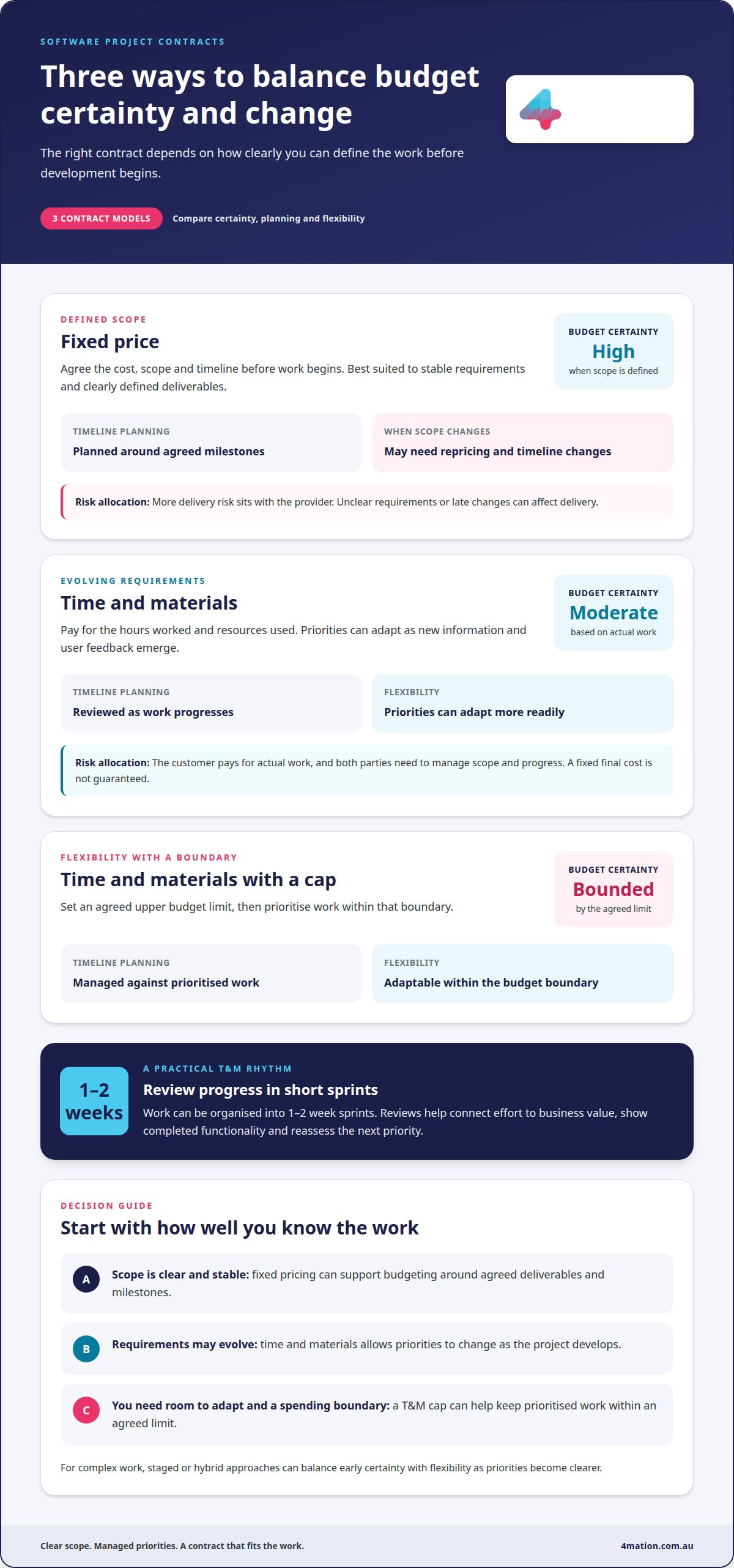
For time and materials, manage costs through regular progress reviews, agreed priorities and clear reporting on hours and work completed. A T&M cap can set an upper budget limit, helping the team prioritise work within an agreed spending boundary.
Option | Budget certainty | Timeline planning | Flexibility
Fixed price | High when scope is defined | Planned around agreed milestones | Scope changes may need repricing
Time and materials | Moderate, based on actual work | Reviewed as work progresses | Priorities can adapt more readily
Time and materials with a cap | Bounded by the agreed limit | Managed against prioritised work | Flexible within the budget boundary
For either model, the project price depends on scope, complexity, required expertise and delivery timeline. A quote should set out the cost for the specific work involved.
Choose fixed pricing when you can define deliverables and acceptance criteria upfront. Choose capped or uncapped time and materials when evolving requirements make flexibility more valuable.
What Is a Time and Materials Contract?
A time-and-materials (T&M) contract charges for the hours worked and resources used. It gives the project team room to adapt delivery as requirements and business priorities change.
Changing requirements and priorities
With T&M, the team can reprioritise work as new information emerges, rather than treating the original scope as fixed. A software project might move a reporting feature ahead of a planned dashboard after users give feedback. Work can be organised into 1-2 week sprints, making progress and upcoming decisions easier to review.
This flexibility can suit product development where needs aren’t fully understood upfront. Requirements may change within a week as users respond or market conditions shift. The trade-off is that the final cost and timeline depend on the work selected and effort involved, rather than a single predetermined total.
Scope changes and risk allocation
Change requests follow different paths under each model. With T&M, the team can estimate the effort and adjust priorities as the project proceeds. In a fixed-price contract, a request outside the agreed scope may require a revised estimate, a timeline change or a new contract before delivery continues.
That difference affects how risk is shared. Fixed-price arrangements place more delivery risk on the provider, while T&M shares more with the customer: the customer pays for actual work, and both parties need to manage scope and progress. T&M offers greater flexibility when requirements change, but doesn’t guarantee a fixed final cost.
Before T&M work starts, the provider analyses requirements and estimates the timeline, resources and costs. You can review the expected work and priorities, then agree on what to proceed with. This planning provides a working estimate without restricting later decisions to the original scope.
During delivery, regular reviews help connect effort to business value. For example, after a sprint, the team can show completed functionality, explain remaining work and discuss whether the next priority still matters. Monthly invoices can include reports on completed work, giving you a view of progress alongside actual charges.
Choose T&M when requirements may evolve and your team can provide ongoing feedback; fixed pricing better suits a defined scope where changes can be managed through formal approvals. If you’re weighing these approaches for a project, you can discuss your project requirements and delivery priorities.
What Is the Difference Between Fixed-Price and Time and Materials?
The models differ in how the agreement guides decisions during delivery, not just how invoices are calculated. When comparing fixed price vs time and materials software projects, consider how your organisation will manage approvals, responsibilities and uncertainty.
Fixed-price contract workflow and requirements
A fixed-price contract turns an agreed project plan into a delivery commitment. As well as describing the software, it should clarify who approves deliverables, how testing works and what happens if a dependency changes. For example, if an external system supplies customer records, the agreement can record who is responsible for access and resolving integration issues.
Time-and-materials contract workflow
A time-and-materials contract needs clear operating rules to keep the work visible as it develops. Set out how the team reports completed work, who can approve tasks and how decisions are recorded. This approach can suit a product with unresolved technical or user needs, provided business stakeholders can respond to findings and keep decisions moving.
Contract choice for large, complex projects
Large projects often include components with different levels of certainty. A staged arrangement can define early discovery separately, then shape later work using what the team learns. For example, an integration project may begin by mapping existing systems before the full development plan is settled. This avoids treating every component as equally predictable.
For software development contracts in Australia, document the parties’ roles, deliverables, payment and reporting arrangements, testing and acceptance process, change approvals, dependencies and handover expectations. The detail should reflect the chosen model: fixed-price agreements need clear boundaries, while time-and-materials agreements need transparent ways to review work and make decisions.
Compare the models against your organisation’s capacity to make decisions. Consider who will resolve questions, how quickly stakeholders can provide input and how the business will judge progress. If approvals are slow, a flexible model may not deliver its full benefit. If requirements are still being investigated, committing every decision upfront may limit useful learning.
For fixed price vs time and materials software projects, the practical choice is the contract your team can actively manage. Align responsibilities and reporting with how your organisation makes decisions, then revisit the arrangement at appropriate project stages as understanding develops.
Advantages and disadvantages of time and materials
The key distinction is how each model handles uncertainty that remains after planning. Time and materials can keep a project moving when the team cannot reliably predict every task. Fixed price can make accountability for a defined delivery clearer, but estimating that commitment requires the provider to account for delivery risk.
For a product roadmap longer than 12 months, T&M can support decisions as the organisation learns what deserves investment. A business may increase specialist capacity for a priority feature, then reduce it when that work is complete. With staff augmentation or a dedicated team, workload and related expenses can be adjusted daily or weekly.
That adaptability has an operational cost: your organisation needs to make decisions and understand what the team’s effort is producing. Hours are not outcomes by themselves. A useful review connects completed work to a business objective, such as reducing manual handling or supporting a new customer process. Without that connection, it’s harder to judge whether the resources involved remain worthwhile.
Fixed-price contracts offer a clearer commitment around a defined result. This can help when internal stakeholders need an agreed delivery plan for budgeting or governance. However, a provider may include a buffer in its estimate to account for uncertainty. If the work becomes more difficult than anticipated, the provider may also have less commercial incentive to prioritise the project, potentially slowing delivery.
The models place different demands on both parties. T&M asks the business to stay engaged with resource use and value. Fixed price asks both parties to define responsibilities and delivery expectations carefully before work starts. Neither arrangement removes the need for sound project governance.
Before selecting a model, consider how your organisation will oversee the work. Identify who owns business priorities, who can make resourcing decisions and how the team’s contribution will be assessed. For example, a product lead may review whether specialist effort is advancing the most valuable parts of a roadmap. Clear ownership connects commercial decisions with delivery.
Choose the model that matches the management approach your project can sustain. T&M can suit evolving, long-term work where you can actively govern resource use. Fixed price can suit a defined commitment where stakeholders value a clear delivery boundary. The stronger arrangement aligns accountability and decision-making with the business result you need.
Fixed-price software development
Good fixed-price software development depends on turning business needs into decisions the delivery team can act on. A practical starting point is a discovery workshop: map the user journey, identify the information needed at each step and record how the software should respond. For a staff approval tool, that could mean documenting how a request moves from submission to review and notification.
Next, the team can translate those decisions into a delivery plan and working design. Screen examples, process diagrams and a prioritised feature list help stakeholders see how the proposed software will work before development advances. This detail makes assumptions easier to discuss while changes are still easier to incorporate into planning.
A useful fixed-price workflow includes these practical checks:
Review the user journey: trace a task from its starting point to its intended result, including exceptions such as missing information.
Confirm the data needs: identify what information users enter, view or update, using a real business process as the example.
Plan verification: map each important behaviour to a test, such as confirming that an approval notification reaches the right role.
Prepare for handover: record operating instructions and ownership for the people who will use or maintain the software.
These steps help the team focus on how the software will work in real business use, not just how it appears in a specification. For instance, a customer portal needs to account for what happens when a user submits incomplete details, not only the successful submission path. Reviewing these scenarios can reveal gaps before they become delivery issues.
Testing also deserves attention in the development plan. A team can verify individual functions, then test a complete user journey across the application. For a booking workflow, that means checking the steps from selecting a service to receiving confirmation. Clear test scenarios give stakeholders a practical way to assess whether the software supports the intended operation.
Finally, treat handover as part of the work, not an afterthought. A short operating guide, access arrangements and a named internal owner can help your team adopt the software after release. The right level of documentation depends on who will support the system and how often its processes are likely to change.
If you’re planning fixed-price software development, discuss your project scope and the business processes it needs to support.
4Mation: Custom Software Development
4mation helps you turn a software investment into a solution shaped around your business goals, users and requirements. If you’re deciding between fixed pricing and time and materials, we can work with you to clarify the scope, identify what may change and choose an approach that supports delivery and budget control.
For a project with stable requirements, such as a defined workflow or customer portal, a fixed-price structure can make sense. We can shape the work around agreed deliverables and acceptance criteria, so progress is measured against a clear outcome. If discovery reveals important unknowns, a staged approach can separate what’s understood from development work that needs more flexibility.
Time and materials may better suit a product where user feedback will influence priorities. Regular reviews help you decide what to build next, keep or defer as the software takes shape. This approach works best when your team can stay involved in decisions and review progress. It gives the work room to adapt, while making ongoing prioritisation important.
Our Custom Software Development is tailored to your business requirements. We can help define the problem, translate business needs into functional scope and develop software that supports your operations or customer experience. For a mobile product, Mobile App Development can bring the service to users on their devices. A browser-based solution may call for Web Application Development instead.
Where AI forms part of the opportunity, AI Consulting & Implementation can help assess its role and apply it to a business need. The right starting point depends on the outcome you want, the information available and how the solution must fit into existing work. The aim is to make a sound investment decision before technical choices become commitments.
To prepare for a discussion, outline the business problem, who will use the solution and what a successful result looks like. Note which requirements are firm and where feedback may change priorities. Those details give us a useful basis for discussing scope, delivery stages and the contract model that fits the work.
If you’re planning a software project and would like to explore the right approach, get in touch with 4mation for a straightforward conversation.
Set your project up for a confident decision
Your next step is to define what a successful investment needs to achieve before deciding how to fund delivery. Identify the business outcome, who will make scope decisions and what evidence you’ll use to measure progress. These points keep contract discussions grounded in value, not just a preference for one billing structure.
The choice between fixed price and time and materials for software projects should also reflect how your organisation makes decisions. If priorities can shift as users respond, plan how your team will review and approve changes. If stakeholders need firm commitments, clarify which requirements must be settled before work begins. A shared view of these decision points can make delivery more deliberate and keep expectations aligned.
4mation can work with you to connect your business goals to a practical software delivery approach. Bring your project idea, known requirements and key uncertainties into the conversation. Together, you can explore what needs to be defined now and where the plan should leave room to adapt.
Talk through your project with 4mation when you’re ready to take the next step. A clear starting point can make your software investment easier to plan and progress.
Frequently Asked Questions
Which Pricing Model Fits Your Project?
Choose the model that matches how clearly you can define the work and how much flexibility you need. A defined deliverable, agreed acceptance criteria and stable requirements can suit a fixed-price contract. If the team needs to explore options, test assumptions or adjust priorities as it learns, time and materials may be more appropriate. For example, a new customer portal with confirmed workflows is easier to scope than an untested product concept.
Which one to pick?
Pick fixed price when you need a committed scope and a clear basis for budget approval; pick time and materials when you value the ability to change direction as the work develops. The decision should also reflect how quickly your organisation can make decisions and provide feedback. If you’re unsure, 4mation can assess your goals, dependencies and requirements through its Custom Software Development work, then recommend an engagement model that fits.
What is the difference between fixed-price and time-and-materials software projects?
The key difference is what the contract holds steady: fixed-price software projects agree a defined scope and price, while time-and-materials projects charge for completed work at agreed rates. When comparing fixed price vs time and materials software projects, consider how changes are handled. A fixed-price change may require a revised scope and price; with time and materials, the team can usually reprioritise work, while total spend can change.
How are software project budgets estimated under fixed-price and time-and-materials contracts?
Under a fixed-price contract, the provider assesses requirements, dependencies, delivery approach and acceptance criteria to estimate the agreed work. That estimate becomes the price for the scope. With time and materials, the budget is forecast from the roles, effort and expected duration, then tracked as work proceeds. For example, integration with an external system may need investigation before its complexity and likely effort can be judged reliably.
What are the advantages and disadvantages of fixed-price software contracts?
A fixed-price contract can make investment approval and financial planning more straightforward because the price is agreed for a defined scope. It also gives both parties a clear reference point for delivery and acceptance. The trade-off is less flexibility: a new feature or changed business rule may need formal approval and a scope adjustment. If requirements are vague at the outset, agreeing a reliable price is harder and assumptions need careful attention.
What are the advantages and disadvantages of time-and-materials software contracts?
Time and materials lets you adapt priorities as user feedback, testing or business conditions reveal what matters most. It can be useful when the team is still validating a product or investigating a complex integration. The trade-off is that final spend depends on the work undertaken, so active prioritisation and regular progress reviews matter. Without clear goals and decision-making, work can continue without delivering enough business value.
Which pricing model is best for projects with uncertain or changing requirements?
Time and materials can be a better fit when requirements are genuinely uncertain, because the team can refine the solution as it learns instead of locking every detail at the start. For example, an early-stage mobile product may need user testing before its core workflows are settled. Keep the work focused on defined outcomes by reviewing progress, deciding what to prioritise next and stopping work that no longer supports the business case.
What risks should clients consider with fixed-price and time-and-materials projects?
With fixed price, the main risks are unclear requirements, hidden dependencies and disagreement about whether a deliverable meets the agreed acceptance criteria. With time and materials, budget drift and unclear priorities can reduce value if progress isn’t reviewed. In either model, agree how decisions, changes, testing and ownership of deliverables will work. For example, document who approves a changed workflow before it affects scope, schedule or future priorities.