
Article
Onshore vs Offshore Software Development: Which Is Right for You
The cheapest development model is not automatically the better business decision. For onshore vs offshore software development in Australia, choose…
Jowena Borral · Software development · 26 October 2026

The cheapest development model is not automatically the better business decision. For onshore vs offshore software development in Australia, choose onshore when close collaboration, quick decisions and local context matter most. Offshore development can widen access to talent and reduce labour costs, but time-zone differences can slow feedback.
It’s understandable to weigh the upfront budget heavily, especially when funding a custom software project. But the real comparison goes beyond rates: communication, delivery oversight, access to the right skills and the protections in your agreements all affect the outcome.
This guide explains the practical differences between onshore and offshore teams, including trade-offs around talent, collaboration and legal protection if a project goes wrong. It also offers a clear way to assess which model fits your priorities, delivery needs and capacity to manage distributed work.
Key Takeaways
Choose a development model by weighing communication, talent access, delivery oversight and total project risk, not cost alone.
Account for time-zone overlap and feedback delays when deciding how closely your team needs to collaborate with developers.
Set clear contract terms, ownership arrangements and quality measures to strengthen your position if delivery goes off track.
For Australian projects involving personal information, the Australian Privacy Act is the Privacy Act 1988, according to the Federal Register of Legislation.
Use the decision guide to match onshore, nearshore or offshore delivery to your project’s priorities and constraints.
Table of Contents
Onshore vs Offshore Software Development: Which is Right for You?
Legal protection: what happens when an offshore project goes wrong?
Onshore vs Offshore Software Development: Which is Right for You?
The best model depends on your project’s scope, decision-making needs and intended lifespan. Compare how each option supports delivery, oversight and future changes, not just the initial estimate.
With stable requirements, a distributed team may suit work that can be divided into clearly defined tasks. If business priorities are still evolving, close access to stakeholders can help developers respond to decisions. A new customer platform with changing user journeys, for instance, may need frequent product-owner input, while a defined integration task may require less day-to-day discussion.
To assess an offshore provider, compare its proposed team, relevant work and delivery approach with your project needs. Ask for a clear breakdown of responsibilities, review points and how changes will be handled. Check how much working time overlaps with your stakeholders, then agree on a shared project system to make decisions, tasks and progress visible.
For regulated or complex work, map the information the software will use and who needs access. The Australian Privacy Act is the Privacy Act 1988, according to the Federal Register of Legislation. Use that context to set clear data-handling expectations and assign responsibility for access, review and escalation before development begins.
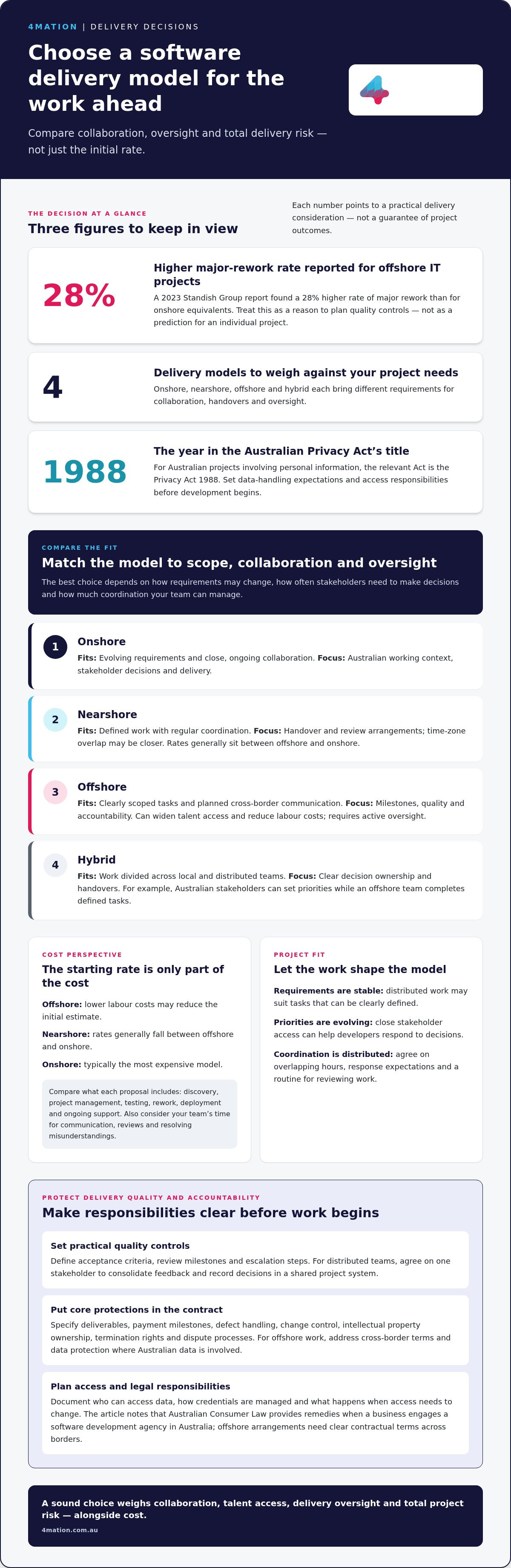
Option | Scope and change | Collaboration | Oversight focus | Relationship fit
Onshore | Suitable for evolving requirements | Australian working context | Stakeholder decisions and delivery | Close, ongoing collaboration
Nearshore | Defined work with regular coordination | Potentially closer time-zone overlap | Handover and review arrangements | Project or continuing work
Offshore | Clearly scoped tasks | Planned cross-border communication | Milestones, quality and accountability | Project or continuing work
Hybrid | Work divided across teams | Local coordination and distributed delivery | Decision ownership between teams | Flexible delivery partnership
Choose the option whose collaboration and oversight demands suit your project’s complexity and future plans.
Hybrid Delivery Models
A hybrid model combines local involvement with development capacity in another country, assigning responsibilities across teams. For example, Australian stakeholders might set priorities while an offshore team completes defined development tasks. This can suit an ongoing platform roadmap, provided decision ownership and handovers are clear.
Time Zones and Communication
Time zones affect when Australian stakeholders can discuss questions with an offshore team. Agree on overlapping work hours, response expectations and a routine for reviewing completed work. This gives the team a predictable process for clarifications and approvals instead of scattering decisions across messages. Where immediate discussion matters, include a local coordination role in the delivery model.
For smoother communication, assign one stakeholder to consolidate feedback and record decisions in the shared project system. This helps prevent conflicting instructions and gives distributed contributors a consistent reference as work progresses.
Legal protection: what happens when an offshore project goes wrong?
If delivery fails, your practical options depend on the contract, the parties’ locations and where the work or data sits. For an Australian engagement, the Australian Consumer Law provides remedies when a business engages a software development agency in Australia. Offshore arrangements need clear contractual terms that address responsibilities across borders.
Offshore development can provide access to larger talent pools and lower labour costs. Nearshore rates generally fall between offshore and onshore, while onshore development is typically the most expensive model. These differences affect the initial estimate, but not the full cost of delivering and maintaining custom software.
Compare each proposal’s hourly rate with the work it covers. Check whether discovery, project management, testing, rework, deployment and ongoing support are included in the scope. If a proposal excludes these activities, its lower starting price may not reflect the full delivery cost. Ask for assumptions and exclusions to be documented.
Total cost of ownership also includes the time your team spends communicating, reviewing work and resolving misunderstandings. An offshore team can increase delivery capacity, but coordinating different working practices and cultures requires active oversight. Nearshore delivery may offer a middle ground, while an onshore team can make direct collaboration simpler.
Rework can change the economics. A 2023 Standish Group report found that offshore IT projects had a 28% higher rate of major rework than onshore equivalents. Treat that finding as a reason to plan quality controls, not as a prediction for an individual project. Define acceptance criteria, review milestones and escalation steps before development starts.
For offshore work, put the core protections in writing. Specify deliverables, payment milestones, defect handling, change control, intellectual property ownership, termination rights and dispute processes. Add cross-border agreement terms and data protection clauses when the project involves Australian data. Clear wording gives both parties a shared reference if delivery diverges from expectations.
Agree on practical controls before granting system access. Document who can access data, how credentials are managed and what happens when a team member leaves. For Australian projects involving sensitive information, include data-handling responsibilities in the contract and delivery plan. These steps make accountability visible across organisational boundaries.
If a project stalls, gather the signed agreement, scope changes, milestone records, review comments and payment history. Compare this evidence with the agreed deliverables and escalation process. A dated record of decisions helps clarify whether the issue concerns missed requirements, changed scope, quality or delayed feedback.
Offshore development’s advantages include access to talent and potential labour-cost savings; disadvantages include coordination demands, cross-border contract complexity and possible rework. For a cost-and-risk review, discuss your project’s delivery requirements and the protections its agreement should address.
Definitions of onshore and offshore software development
For an Australian business, “onshore” and “offshore” describe where the development team is based. Onshore software development uses a team in Australia; offshore development engages a team in another country. The distinction is geographical, not a measure of quality, ownership or project success. For example, a team building a customer portal from within Australia is onshore for an Australian organisation.
What onshore and offshore mean in practice
Location affects how your organisation plans collaboration, shares information and coordinates delivery. An Australian product lead working remotely with developers elsewhere in Australia still has an onshore team. A business engaging developers based overseas has an offshore team, even if its project manager works in Australia. Identify where the people doing the work are based, not just where the contract was signed.
“Nearshore” describes a team in a neighbouring country, often with a closer time zone and a shared language of communication. It sits between onshore and offshore as a location category, but the label alone says little about the working relationship. Map the team’s location and planned collaboration hours before treating a nearshore arrangement as operationally close.
Development location versus outsourcing
Development location and outsourcing are different concepts. “Onshore” or “offshore” describes where developers work; “outsourcing” describes whether another organisation supplies the work. An Australian business can build software with its own onshore employees or outsource development to an Australian partner. It can also outsource to an offshore provider or employ its own staff in another country.
This distinction matters when comparing proposals. A local development team employed directly by your business is onshore, but it is not outsourcing. A contracted Australian supplier is both onshore and outsourced. A contracted team in another country is offshore outsourcing. Record these arrangements separately in project documents, including who employs each developer and who directs their work.
How to describe your arrangement clearly
Use a simple description when discussing delivery with executives, procurement and project teams. State the team’s country, whether it is internal or supplied by a partner, and who manages daily work. For example: “Our Australian product team works with an outsourced development team based overseas.” This separates location, sourcing and management instead of compressing them into one label.
For a mixed setup, describe each group and its responsibilities. Australian stakeholders might define business priorities while an overseas team handles agreed development tasks. The delivery is hybrid, but each team still has a location and employment relationship. Documenting these details helps stakeholders understand who owns decisions, where collaboration happens and how work moves between teams.
Before comparing models, define the delivery structure in three steps: identify each team’s location, state whether it is internal or outsourced, and assign responsibility for decisions and work. This gives your organisation a precise basis for discussing collaboration, accountability and the type of partner the project needs.
Offshore software development and global talent access
International hiring can broaden the talent available to an Australian project. The practical question is whether a proposed team’s skills match the work and suit your delivery model.
Local and International Talent
Local recruitment gives your organisation access to developers who can work directly with Australian stakeholders. International recruitment expands the talent pool beyond the local market. If your team needs experience maintaining a particular platform, for example, compare local candidates with offshore teams that have delivered similar work. Focus on the required capability instead of assuming location determines suitability.
Start by listing the roles and skills your project needs, such as mobile development, interface design or systems integration. Then compare candidates’ responsibilities and relevant project experience. This helps you determine whether a local hire, an international team or a mix of both fills the actual gaps in your delivery plan.
Technical Talent and Specialisation
Technical specialisation varies between teams, even within the same country. A provider in India may propose developers with experience relevant to your platform, while an Australian team may bring a closer understanding of local workflows. Assess the people assigned to your work by reviewing their past responsibilities and how they would address your specific requirements.
A project connecting older business systems, for example, may need developers who understand existing data structures and integrations. A new mobile application may call for experience designing for mobile users. List the capabilities each workstream needs, then compare proposed team members against those requirements. This keeps the discussion grounded in evidence about the people doing the work.
Costs and Talent Access
Offshore development can provide access to talent beyond Australia, while local hiring can involve higher labour costs and competition for particular skills. Compare the proposed team’s experience, roles and delivery responsibilities alongside its rate. A lower rate is useful only if the team can complete the work to the required standard and your organisation can coordinate delivery effectively.
Assess the full staffing plan, not just the number of developers. Identify who will lead technical decisions, review completed work and resolve blockers. A team with the right specialist but no clear review process, for instance, may create extra coordination demands for your internal staff. Include these responsibilities in the comparison so the decision reflects the working arrangement as well as access to skills.
Common Offshore Destinations
India and the Philippines are common offshore destinations for Australian companies seeking software development talent. Assess each proposed team on its own skills and project experience. Compare candidates from these countries against the same role descriptions and delivery requirements you would use for Australian applicants.
For a practical comparison, ask for a clear outline of the proposed team’s roles, relevant work and communication arrangements. Consider how developers will collaborate with your product and technical stakeholders and how progress will be reviewed. This helps you judge whether a specific team can contribute the capabilities your project needs, rather than relying on assumptions about its location.
Onshore software development benefits and drawbacks
Onshore development offers closer collaboration and Australian market context, but usually comes with higher labour costs. Its value depends on whether those advantages matter enough for your project’s scope and delivery needs.
Onshore Development Benefits
An Australian team can make it easier to discuss changing requirements with the people building your software. Shared working hours support direct conversations, and face-to-face meetings can help stakeholders resolve detailed questions together. For example, a Melbourne operations team can walk through a workflow with local developers and agree on changes during the same working day.
Local knowledge can also help teams understand Australian customer expectations and business culture. That context matters when a platform needs to reflect local processes, language or market needs. An onshore team may also work within a more familiar legal, tax and privacy-policy environment, which can simplify coordination between your organisation and its development partner.
For projects with an evolving scope, close collaboration can help your team make decisions as new information emerges. Product owners can review progress, explain priorities and discuss trade-offs directly with developers. This is useful when business stakeholders need regular input into design or functionality, rather than handing over a fixed specification and waiting for delivery.
Onshore Development Drawbacks
Higher labour costs are a clear trade-off for Australian businesses comparing local teams with offshore alternatives. Local talent is also competitive, so hiring an onshore development team may take weeks or months. That can affect a project’s start date, especially if it depends on a specialist skill or several roles becoming available together.
Local delivery does not remove the need for strong project management. An Australian team still needs clear scope, decision-makers, acceptance criteria and regular reviews. If stakeholders delay feedback or requirements remain unclear, the project can lose momentum regardless of where developers work. Location can ease communication, but it cannot replace timely decisions.
The skills available in a local team may not match the project’s technical needs. If your organisation needs a specialist for a particular platform, a local search may limit options or extend hiring. In that case, compare the value of local collaboration with the benefit of accessing talent beyond Australia.
Use three checks to decide whether onshore delivery suits your project: how often requirements may change, how quickly stakeholders need to make decisions, and how important local context is. If these factors carry significant weight, local collaboration may justify the higher cost. If the scope is stable and the required skills are scarce locally, another delivery model may better fit your priorities.
Discuss your software project’s delivery needs to weigh local collaboration, team availability and scope before choosing an approach.
4Mation: Custom Software Development
4mation Technologies helps Australian organisations turn complex requirements into software built around their business. If you’re weighing local collaboration against offshore capacity, we can work with you to define the scope, delivery approach and skills your project needs.
Our Custom Software Development, Web Application Development and Mobile App Development services support projects ranging from tailored business platforms to customer-facing applications. Where AI addresses a clear business need, we also provide AI Consulting & Implementation. We focus on practical solutions that fit your users, workflows and long-term goals, without unnecessary complexity.
Contact 4mation to discuss your software project.
Set your project up for confident delivery
Choosing onshore vs offshore software development in Australia is a business design decision, not simply a sourcing choice. Before committing, turn your priorities into practical delivery conditions: who needs to make decisions, how the team will share progress, what must remain under your organisation’s control, and how success will be assessed.
Use these conditions to shape a delivery plan that supports your users and business goals. A well-defined scope, clear responsibilities and a workable decision process give everyone a shared basis for moving forward. They also help you adapt the plan as your organisation’s needs evolve, while keeping sight of the outcome the software must deliver.
If you’re ready to translate your requirements into a considered next step, discuss your project with 4mation. A clear starting point can make the path from business need to working software more manageable. Your next decision can be practical, informed and focused on lasting value.
Frequently Asked Questions
Nearshore vs Offshore and Onshore Outsourcing: Which is Better?
Neither model is universally better; the right fit depends on the work and how your organisation manages delivery. Nearshore teams work in neighbouring countries, while offshore teams are based farther away, often across larger time differences. Outsourcing describes engaging an external provider, not its location. An Australian business can outsource locally or offshore. Compare team expertise, collaboration needs, accountability and contract terms before choosing.
When does onshore development earn its premium?
Onshore development can justify higher labour costs when frequent stakeholder decisions shape the product. A project involving evolving customer workflows, complex integrations or sensitive operational processes may benefit from direct collaboration. If a product owner needs to review prototypes and regularly adjust priorities, for example, shared working hours can keep decisions moving. The premium is less compelling when work is tightly specified and needs little ongoing input.
What is the difference between onshore and offshore software development in Australia?
Onshore development means developers are based in Australia; offshore development means they work in another country. The distinction affects more than meeting times: it can shape how your organisation manages teams, grants system access and documents projects. A procurement brief, for example, can record each team’s location, employer and decision-making responsibilities. This makes proposals easier to compare and clarifies accountability for each delivery activity.
What are typical software developer rates in Australia compared with offshore countries?
Rates vary with seniority, technical specialisation, provider structure and the work included. A headline hourly rate alone will not show whether a proposal includes technical leadership, testing, delivery coordination or support. Compare equivalent roles and responsibilities, then assess estimated effort against the same scope. For example, compare a senior developer with another senior developer, rather than measuring a blended offshore team rate against one Australian specialist.
How much does it cost to build software with an Australian onshore team versus an offshore team?
Total project cost depends on scope, team composition, delivery duration and the coordination your organisation needs to provide. A lower hourly rate does not automatically mean a lower final cost if the estimate excludes testing, project management or later changes. Ask each bidder to price the same deliverables, assumptions and acceptance criteria. Then compare proposed effort, included activities and ongoing ownership requirements, not just the initial estimate.
What are the advantages and disadvantages of onshore software development in Australia?
Onshore teams can make it easier to collaborate with stakeholders, discuss changing priorities and apply local market context. The trade-offs include higher labour costs and competition for Australian technical talent. For a project requiring regular workshops with a client team, local delivery may support faster decisions. For a stable, well-documented task, those benefits may matter less. Assess how much direct stakeholder input the work genuinely needs.
What Australian privacy, data security and intellectual property rules apply to offshore software development?
Australian projects handling personal information may need to comply with the Australian Privacy Principles under the Privacy Act 1988, according to the Federal Register of Legislation. Offshore delivery can require cross-border agreements and additional data protection clauses. Set out data access, security responsibilities and permitted uses in the contract. Also specify who owns bespoke code, documentation and other project outputs, and define how those materials transfer at project completion.
What are the risks of offshore software development, and how can they be managed?
Common risks include delayed feedback, unclear ownership, rework and gaps between agreed requirements and delivered work. Reduce these risks by defining acceptance criteria, assigning a decision-maker and documenting changes in one project system. Set review points for working software, not just written status updates. For example, schedule regular demonstrations against agreed user workflows, then record decisions and outstanding issues so both teams share the same delivery record.