
Article
Strapi Development Services in Australia for Custom CMS Builds
Your CMS should fit the way your business works, not force your teams into a fixed content model. Strapi development services in Australia can shape…
Jowena Borral · Software development · 2 November 2026

Your CMS should fit the way your business works, not force your teams into a fixed content model. Strapi development services in Australia can shape a custom CMS around your content, users and digital channels. This can include designing content structures, setting access permissions, connecting APIs and integrations, and pairing Strapi’s flexible backend with the front end your customers use.
A working content platform is only the starting point. Your teams need a system they can use confidently, and your business needs room to adapt as its content requirements change. This guide explains how Strapi providers approach custom builds, support enterprise content needs, choose suitable technologies and plan ongoing maintenance.
You’ll also learn what to consider when defining project scope and support, and how integrations, content workflows and front-end decisions shape the finished solution. The aim is to explain the practical steps behind a dependable Strapi CMS, so you can make informed decisions about the build and its long-term role in your business.
Key Takeaways
Define post-launch support and communication needs early so maintenance responsibilities are clear after deployment.
Plan content structures, permissions and asset management around how your teams create and manage content.
Choose frontend, API and infrastructure technologies to suit your channels, integrations and operational needs.
Assess providers by how their project approach, relevant experience and ongoing support align with your requirements.
When a custom CMS needs to connect with wider business systems, 4mation can help shape the solution through custom software and web application development.
Table of Contents
Do you offer ongoing support and maintenance for Strapi CMS projects?
What Strapi development services do Australian agencies offer?
Do you offer ongoing support and maintenance for Strapi CMS projects?
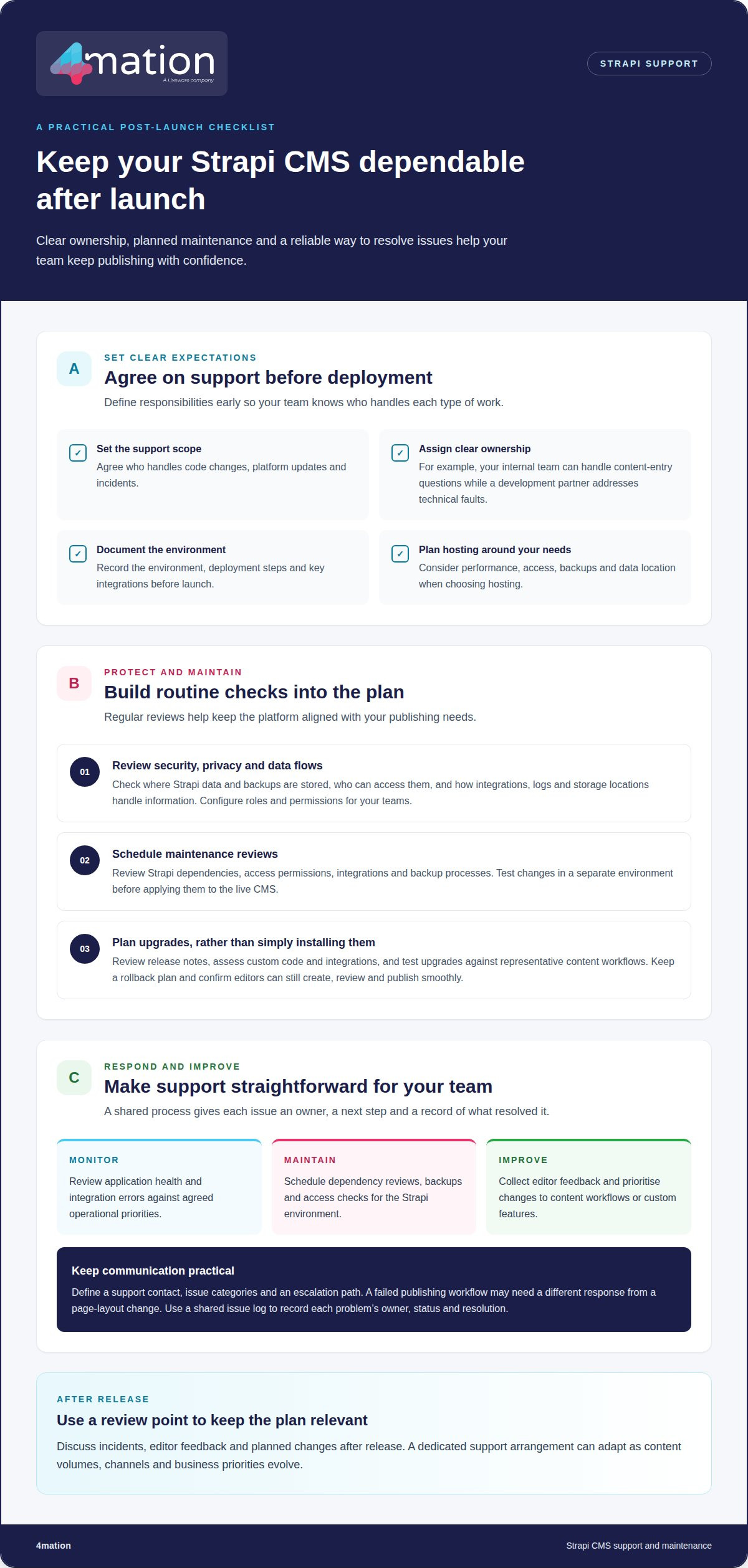
Ongoing support can cover Strapi upgrades, maintenance, hosting coordination and issue resolution after launch. Agree on the scope before deployment, including who handles code changes, platform updates and incidents. For example, a support plan might assign content-entry questions to your internal team and technical faults to a development partner.
For security, privacy and data residency, assess where Strapi data and backups are stored, who can access them, and how connected services handle information. Configure Strapi roles and permissions for your teams, then review data flows through integrations, logs and storage locations before deployment.
Australian agencies can help plan hosting, deploy the Strapi environment, and manage updates and support after launch. The hosting choice should reflect your performance, access, backup and data-location needs, while a written support process should set out how issues are reported and resolved.
Clear communication gives your team a practical route from an issue to a resolution. Define a support contact, issue categories and escalation path before launch. A failed content publishing workflow, for instance, needs a different response from a request to change a page layout. Record decisions and fixes so recurring issues are easier to diagnose.
Routine maintenance keeps the CMS aligned with how your organisation publishes content. A planned review can check Strapi dependencies, access permissions, integrations and backup processes. Test changes in a separate environment before applying them to the live CMS. This helps identify problems before they affect editors or the customer experience.
Strapi upgrades need planning, not just installation. Review release notes, assess custom code and integrations, then test the upgrade against representative content workflows. A staged release can reveal compatibility issues before the updated CMS reaches production. Keep a rollback plan and confirm editors can still create, review and publish content smoothly.
A practical post-deployment support process can include these steps:
Monitor: Review application health and integration errors against agreed operational priorities.
Maintain: Schedule dependency reviews, backups and access checks for the Strapi environment.
Improve: Collect editor feedback and prioritise changes to content workflows or custom features.
Use a shared issue log to link each reported problem with its owner, status and resolution. For example, an API error affecting a mobile app should identify the integration and next action. This gives product and technology teams a consistent view of support work.
Before launch, document the environment, deployment steps and key integrations. Set a review point after release to discuss incidents, editor feedback and planned changes. A dedicated support arrangement can then adapt as content volumes, channels and business priorities evolve.
Enterprise suitability and content management
Strapi can suit enterprise content needs when teams need flexible content management across web, mobile and other platforms. Project timelines depend on content scope, integrations, approvals and testing. The build typically moves from requirements and architecture through modelling, development, testing and launch.
Content architecture and development process
Start by mapping content to the teams and channels that use it. A product description, campaign page and support article each need different fields, owners and approval steps. Strapi’s headless architecture separates the backend from the front end, allowing content to serve websites, mobile apps and other digital platforms. Document user roles, publishing workflows and integrations before development begins.
To assess enterprise suitability, consider how the architecture handles extensive content and editorial responsibilities. Strapi includes authentication and customisable user roles for managing permissions. Define who can create, edit, approve and publish each content type. For example, a regional editor might update local pages while a central team manages shared brand information.
Content modelling and API generation
Content modelling defines the fields and relationships behind each entry. Strapi lets teams create flexible content types tailored to business requirements. A product model might include a name, description, images and category, while a campaign model could connect to related products. Review these models with editors and developers before building dependent platforms.
Strapi’s API-first approach supports RESTful and GraphQL APIs for content distribution and integration. Agree which API each platform needs, then define which fields it can access. This gives developers a clear contract for connecting a website or app and helps prevent unnecessary content from appearing in a response.
Mobile content management also needs deliberate modelling. Check how fields display on smaller screens, whether images need different treatments, and which content must appear in the app. For example, a location record could provide opening details to both a mobile app and a website. Testing shared content across both platforms helps reveal gaps before launch.
Plan multilingual content around the languages, regions and editorial workflows your organisation supports. Define how translated entries relate to the original, who reviews each version, and what happens when source content changes. A language matrix can show which pages need translation and which teams own approval. This keeps regional publishing coordinated without duplicating unrelated content.
To build and launch, teams first confirm requirements, content models and integrations. They then develop the Strapi backend and connect each front end. Before deployment and editor handover, testing covers permissions, APIs, content display and publishing workflows.
Before committing to an architecture, document representative content, users and channels. A focused content architecture discussion can help turn those needs into a practical build plan.
Frontend, backend, database and infrastructure technologies
Technology choices shape how reliably your CMS performs as business demands change. Assess each layer against expected traffic, content complexity, security needs and the skills available to maintain it. The right stack should support the required user experience without adding components your organisation won’t use.
Front-end decisions affect page speed, accessibility and how easily teams can evolve digital interfaces. Consider whether the website needs server-rendered pages, interactive client-side features or a combination. A content-heavy public site, for example, may prioritise fast page delivery, while a logged-in customer portal may need richer interactive functions. Match the rendering approach to actual user journeys.
On the backend, identify where custom business rules belong. Strapi’s Node.js foundation can be extended to handle project-specific logic, but each custom function adds to what must be tested and maintained. A product catalogue might need validation before a record can be published. Keep rules explicit, document their owners and avoid duplicating the same decision across services.
Choose a database based on the shape and use of your information. Map entities, relationships and the records users need to find quickly. A service directory, for instance, may rely on filtering by region and category, while an editorial archive may centre on dates and topics. Use these real queries to guide data design and performance testing.
Infrastructure decisions determine how teams deploy changes and respond to service issues. Separate development, test and production environments so new features can be checked without affecting live users. A release pipeline can run automated checks before deployment, while monitoring can surface application errors for investigation. Define who owns each environment and how teams recover from a failed release.
Build security and operational controls into the technical design. Set access boundaries for developers, editors and automated services. Store credentials outside application code, and restrict production access to authorised roles. If your organisation has several internal teams, document who approves access changes and how those decisions are recorded.
Assess technical capability through a concrete architecture walkthrough. Ask developers to explain how they would test a publishing rule, diagnose a slow query and roll back a release. Their answers should connect the design to your operating requirements, not simply name familiar technologies.
Frontend: Choose rendering and interface patterns around real user journeys.
Backend: Keep custom rules clear, testable and owned.
Database: Model information around the searches and relationships users need.
Infrastructure: Separate environments and define release, access and recovery procedures.
Documenting these choices gives technology and business teams a shared reference for evaluating trade-offs. It also helps future developers understand why the architecture works as designed, making later changes easier to scope and assess.
Companies presented as Strapi development providers
Strapi development services in Australia should connect technical decisions with your content workflows, integrations and business priorities. Compare providers by how they scope a build, explain trade-offs, manage delivery and approach ongoing support. Strapi experience matters, but so does a clear plan for making the CMS useful to your teams.
Australian and offshore developers can both deliver Strapi projects. Compare practical factors such as working-hour overlap, workshop access, communication routines and how teams record decisions. A provider working across time zones may rely more on written handovers, while shared working hours can make live planning sessions easier to arrange.
Location alone doesn’t show whether a provider is right for your project. Ask each development company to explain a relevant scenario, such as connecting Strapi content to a customer portal. The response should cover the integration, content ownership, testing approach and post-launch responsibilities. This shows how well the provider connects technical delivery with the experiences your users need.
Review portfolios and case studies for projects with comparable scope. Look beyond screenshots to understand the content types, channels, integrations and operational requirements involved. A website-only build differs from a CMS serving both an app and business systems. Relevant examples help you discuss design choices and delivery risks in practical terms.
Use the same evaluation criteria for each provider. Request a proposed delivery sequence, clear responsibilities and the reasoning behind technical recommendations. Compare how teams approach content modelling, API integration, testing and handover. If requirements change, ask how decisions are documented and the impact on scope and delivery is assessed.
Project fit: Compare experience with your content workflows and connected platforms.
Communication: Establish meeting routines, decision records and escalation contacts.
Delivery: Review testing, deployment, documentation and handover plans.
Ongoing care: Agree who manages upgrades, maintenance and support after launch.
Changing development companies mid-project is possible, but it can cause delays and additional costs. A new team needs to understand the codebase, deployment process, integrations and outstanding decisions. Strapi development services in Australia can involve different delivery models, so keep documentation, repository access and a clear record of completed work available throughout the project.
Project cost depends on scope, integrations and ongoing support requirements. A provider should explain how these factors shape the proposed work and set out the deliverables after understanding your requirements. Compare the assumptions behind each proposal, not just its total, to see what the project includes.
Before choosing a provider, prepare a brief covering business goals, content types, platforms, integrations and support expectations. Share it consistently in provider discussions. This makes it easier to compare delivery approaches and identify a team that can explain its technical decisions clearly and take responsibility for the project’s progress.
What Strapi development services do Australian agencies offer?
Australian Strapi agencies can help turn content requirements into a working CMS, from early planning through launch. Professional developers provide technical guidance and apply development best practices. The scope often spans discovery, custom configuration, API connections, frontend delivery and post-launch care.
Discovery translates business needs into a delivery plan. An agency can map publishing workflows, user groups, content types and connected systems before recommending an architecture. For example, a business publishing product information across a website and mobile app needs clear rules for shared fields, approvals and updates. This groundwork helps teams agree on what the CMS must support.
Strapi configuration shapes the editorial experience. Developers can build content types, set up roles and permissions, and organise relationships between content. A team might need separate workflows for product updates and corporate news. Agencies can translate those differences into CMS structures, giving editors relevant fields and reducing reliance on technical teams for routine publishing.
API and integration work connects Strapi content with other platforms. Developers can plan RESTful or GraphQL access, then connect systems such as websites, mobile applications or eCommerce services. A project might send product descriptions to a storefront while another application uses the same source content. Integration planning should define what data moves, which system owns it and how errors are handled.
Front-end development turns CMS output into useful customer experiences. An agency may connect Strapi to an existing website or build a new interface around your users’ journeys. The work can include page templates, content display and testing across devices. Keeping the front end separate from the CMS lets teams adapt channels without rebuilding their content foundation.
Agencies can also support migration from a legacy CMS. Start with an inventory of pages, media and metadata. Then map old fields to Strapi models, clean the content and test representative records before migrating everything. This staged approach helps uncover missing fields and broken relationships while the existing site remains available.
Testing and deployment prepare the solution for day-to-day use. Developers can check API responses, permissions, integrations and editorial tasks, then document release and handover steps. After launch, support can cover defect resolution, maintenance and planned improvements. Define these responsibilities early, especially if internal teams will manage hosting or routine content changes.
When comparing service proposals, look for clear deliverables across each stage: agreed requirements, a documented content model, tested integrations and an editor handover. Ask how technical decisions connect to your business goals, and how the agency will communicate progress and manage changes. Discuss your Strapi project requirements to identify a suitable path from planning to delivery.
4Mation: Custom Software Development
4mation helps organisations plan and build custom software around their business requirements. If your CMS needs to support specific workflows, connect with existing systems or serve content across digital channels, we can work with you to define the right solution. Our focus is on aligning the architecture and delivery approach with your goals, rather than adding complexity without a clear purpose.
Our custom software development can support a wider CMS project, including connected web applications or mobile experiences. If you’re assessing how Strapi could fit your technology environment, contact 4mation to discuss your project.
Turn your CMS plans into a practical next step
Choosing a custom CMS also means deciding how your organisation will adapt its content operations over time. Before selecting Strapi development services in Australia, clarify the business outcomes you need, the teams involved and the systems the solution must connect with. This gives decision-makers a stronger basis for choosing what to build now and what can evolve later.
4mation can work with you on the wider technology needs around your CMS, including Custom Software Development, AI Consulting & Implementation and Mobile App Development. The right starting point is a shared understanding of your priorities, existing environment and intended outcomes. From there, you can shape a considered path forward without adding complexity that doesn’t serve your business.
Bring your project goals and key requirements to the conversation, whether you’re planning a new build or considering how Strapi could fit your existing digital environment. Contact 4mation about your Strapi project and take the next step with a clearer direction.
Frequently Asked Questions
How can a Strapi development company help me build a custom CMS for my business?
A Strapi development company can turn your requirements into a delivery plan with clear acceptance criteria. For example, agree how an editor should preview a draft, what happens when required information is missing, and how a release will be approved. These details help your team judge whether the finished CMS supports its intended work, rather than relying on a feature list alone.
Why Choose Us for Strapi Development in Australia?
Consider 4mation when your Strapi project sits within a broader software change, rather than as an isolated platform decision. 4mation’s capabilities include Strapi, system integration and digital strategy. This can be relevant if your project also involves replacing manual processes or connecting a new CMS with existing software. Start by outlining the business outcome you need, then assess how the proposed work supports it.
How does a Strapi CMS development partner help in building scalable digital experiences?
A development partner can help you plan for growth beyond website traffic. Content volume, editor numbers and the complexity of publishing approvals can also affect performance and administration. Load testing can examine how a key page behaves under expected demand, while a review of editorial tasks can reveal bottlenecks. These checks give your team evidence to prioritise future improvements.
Why Hire a Professional Strapi Development Agency?
A professional agency can provide specialist engineering capacity when your internal team has competing priorities or lacks relevant experience. It can also help define technical acceptance tests, such as confirming that a critical publishing task works across supported browsers. Agreeing on these tests before development gives stakeholders a shared way to assess delivery and reduces ambiguity during project reviews.
Which Australian agencies specialise in Strapi development?
4mation includes Strapi among its technology capabilities and provides custom software development for business requirements. If you’re assessing whether its approach fits your project, prepare a short brief covering the intended users, business outcome and systems involved. That gives both sides a concrete basis for discussing the work, including whether Strapi should be part of a wider digital solution.
What should businesses look for when choosing a Strapi development agency?
Look for clear commercial controls alongside technical capability. A proposal should distinguish agreed deliverables from assumptions, explain how scope changes are handled and identify who approves key decisions. Clarify ownership of the code repository, deployment accounts and project documentation, too. These points help your organisation retain oversight and understand what it needs to operate the solution after delivery.
What integrations do Australian Strapi developers commonly provide?
Integration needs vary by business, but a Strapi project may connect with a CRM, customer support platform, identity service or analytics tool. Linking content to a CRM, for example, could help keep business information consistent across systems. Map the information each connection needs, who owns it and what should happen when a transfer fails. This helps teams define integration requirements before implementation begins.